
Biomechanics of Walking: Why Your Gait Pattern Matters
Biomechanics of Walking: Why Your Gait Pattern Matters
You walk every day.
Whether you exercise intentionally or simply move from point A to point B, walking is the most repeated movement pattern in your life.
If your gait mechanics are inefficient, that repetition can slowly create knee pressure, hip discomfort, or low back tightness.
At Function Thru Fitness in Green Bay, WI, biomechanics assessment often begins with how someone walks.
What Is Gait?
Gait is simply the technical term for walking.
A proper gait cycle follows a predictable sequence:
• Heel strike
• Mid stance
• Push-off through the big toe
• Opposite arm swing coordination
That sequence repeats thousands of times per day.
When mobility limitations exist in the ankle, knee, or hip, compensation patterns begin to develop.
Heel Strike and Transition
Proper walking begins with the heel contacting the ground slightly on the lateral (outside) portion.
From there, weight transitions:
Outside heel → midfoot → big toe
The big toe is critical. It allows you to push force into the ground and propel forward.
If that transition is limited due to ankle stiffness or toe restriction, force travels up the chain.
That’s when we start seeing increased pressure in:
• Knees
• Hips
• Lower back
Arm Swing Matters More Than You Think
One of the simplest ways to improve gait at home is exaggerating opposite arm swing.
As the right leg steps forward, the left arm swings forward.
This natural reciprocal pattern promotes efficient rotational mechanics.
Trying to consciously think “heel, midfoot, big toe” often creates overthinking and stiffness.
Instead, focus on:
• Relaxed but intentional arm swing
• Slight exaggeration to restore rhythm
• Smooth outside-to-inside weight transfer
Ankle Mobility: The Foundation
If ankle mobility is limited, the entire gait cycle suffers.
Many clients in Green Bay present with excessive plantar flexion — essentially walking too much on their toes.
When that happens:
• Calves become overly tight
• Shin muscles weaken
• Heel strike control diminishes
• Knee pressure increases
The anterior tibialis (front of the shin) plays a major role in controlling deceleration from heel strike to flat foot.
If that muscle is weak, walking efficiency decreases.
Two At-Home Tools to Improve Gait
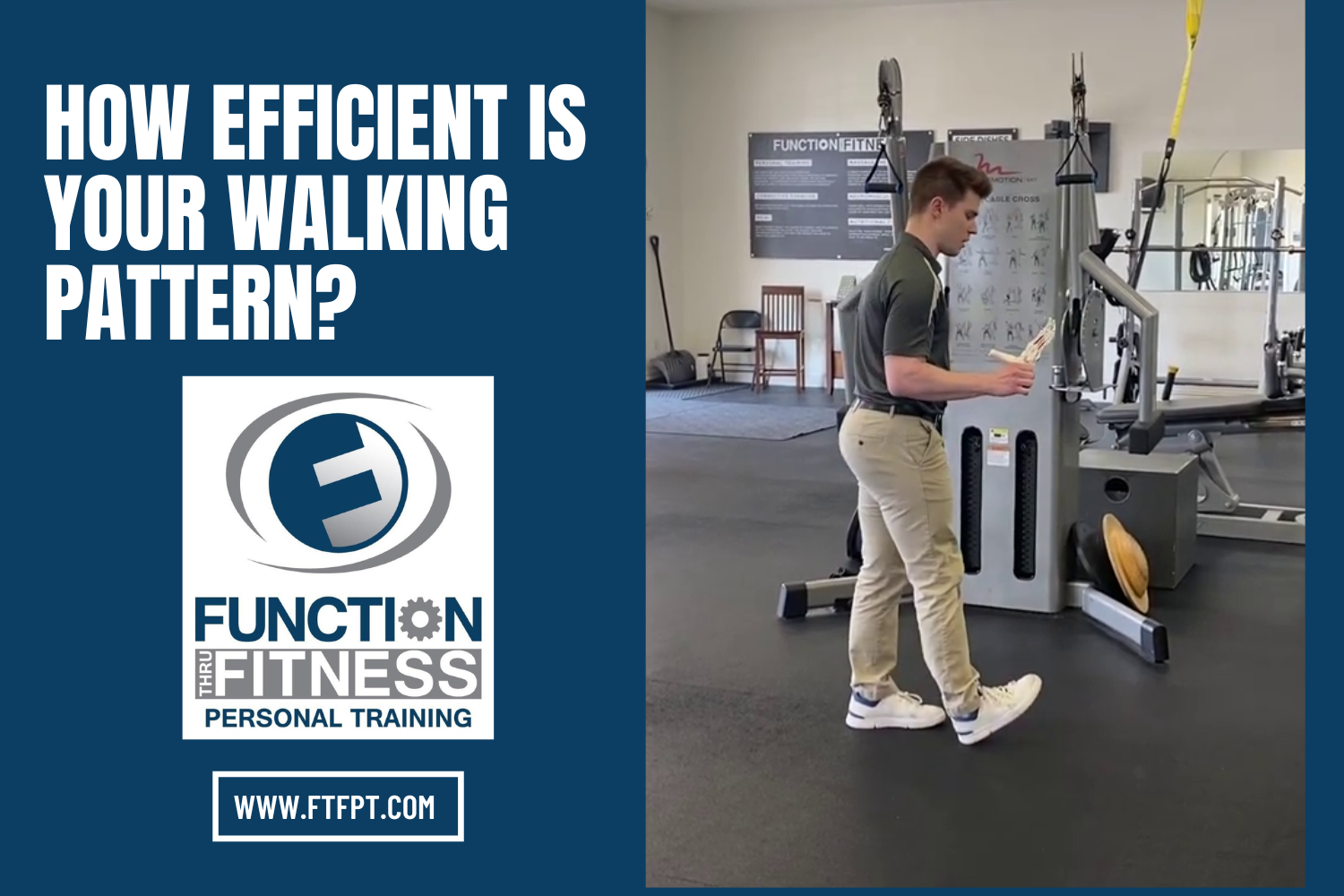
In this video, John demonstrates two simple exercises:
Tibialis Raise with Bar
• Bar placed across toes
• Knees mostly straight
• Pull toes toward shins
• Control slow return (2–3 seconds)
• Repeat for 2 sets of 20
This strengthens the shin and reduces calf dominance.
Wall Tibialis Raise
• Back against wall
• Feet flat
• Pull toes toward shins
• Control the lowering phase
• Move further from wall to increase difficulty
Even small improvements in ankle mobility can reduce pressure at the knees and hips.
Center of Mass and Compression
Some individuals present with excessive forward compression — what John describes as being “smushed like a pancake.”
When the center of mass shifts forward excessively:
• Alternating gait becomes inefficient
• Arm swing decreases
• Steps become rigid
• Energy cost increases
Restoring ankle mobility and reciprocal motion helps re-center the body.
Why Biomechanics Assessment Matters
As the only Certified Biomechanics Specialist in Green Bay, John evaluates:
• Center of mass alignment
• Ankle mobility
• Knee tracking
• Hip stability
• Arm swing coordination
Walking is foundational. If gait improves, everything up the chain improves to a degree.
That includes:
• Squats
• Lunges
• Golf swings
• Running mechanics
• Daily movement
If you want to move more fluidly and reduce joint pressure, improving gait is a smart starting point.
Watch the full video to learn how to evaluate your own walking pattern and try the two ankle mobility exercises demonstrated.
If you’re in Green Bay, WI and want a professional biomechanics assessment, schedule a consultation at Function Thru Fitness.
FAQ SECTION
Q - What is a proper gait pattern?
A - A proper gait pattern begins with lateral heel strike, transitions through midfoot, and pushes off the big toe with opposite arm swing coordination.
Q - Can ankle mobility affect knee pain?
A - Yes. Limited ankle mobility can increase stress on the knees and hips during walking.
Q - How can I improve my walking mechanics at home?
A - Focus on reciprocal arm swing and strengthen the anterior tibialis muscle using controlled toe raises.
Looking for a better way to stay strong, mobile, and pain-free as you age?
At Function Thru Fitness, we go beyond big-box gyms. As one of the established fitness centers green bay wi, our focus is on restoring how the body moves, reducing pain, and building long-term strength through a proven function fitness approach.
We help people move better at every stage of life through personalized training, corrective exercise, golf fitness, neuromuscular therapy, and athlete recovery.
Download our free guide:
Essential Exercises for Lifelong Mobility and Independence
www.ftfpt.com/essential-exercises
Visit us at 801 Hoffman Rd. Suite 103, Green Bay, WI
Book online at www.ftfpt.com