
Forearm Flexor Stretch: How to Relieve Wrist Tightness and Reduce Forearm and Elbow Discomfort
Most people do not think about their forearm flexors until something hurts. A dull ache at the elbow. Wrist stiffness that will not go away. Difficulty pressing the palm flat against a surface. These are the quiet signals that tightness has been building for a while — and that the forearm flexors are overdue for attention.
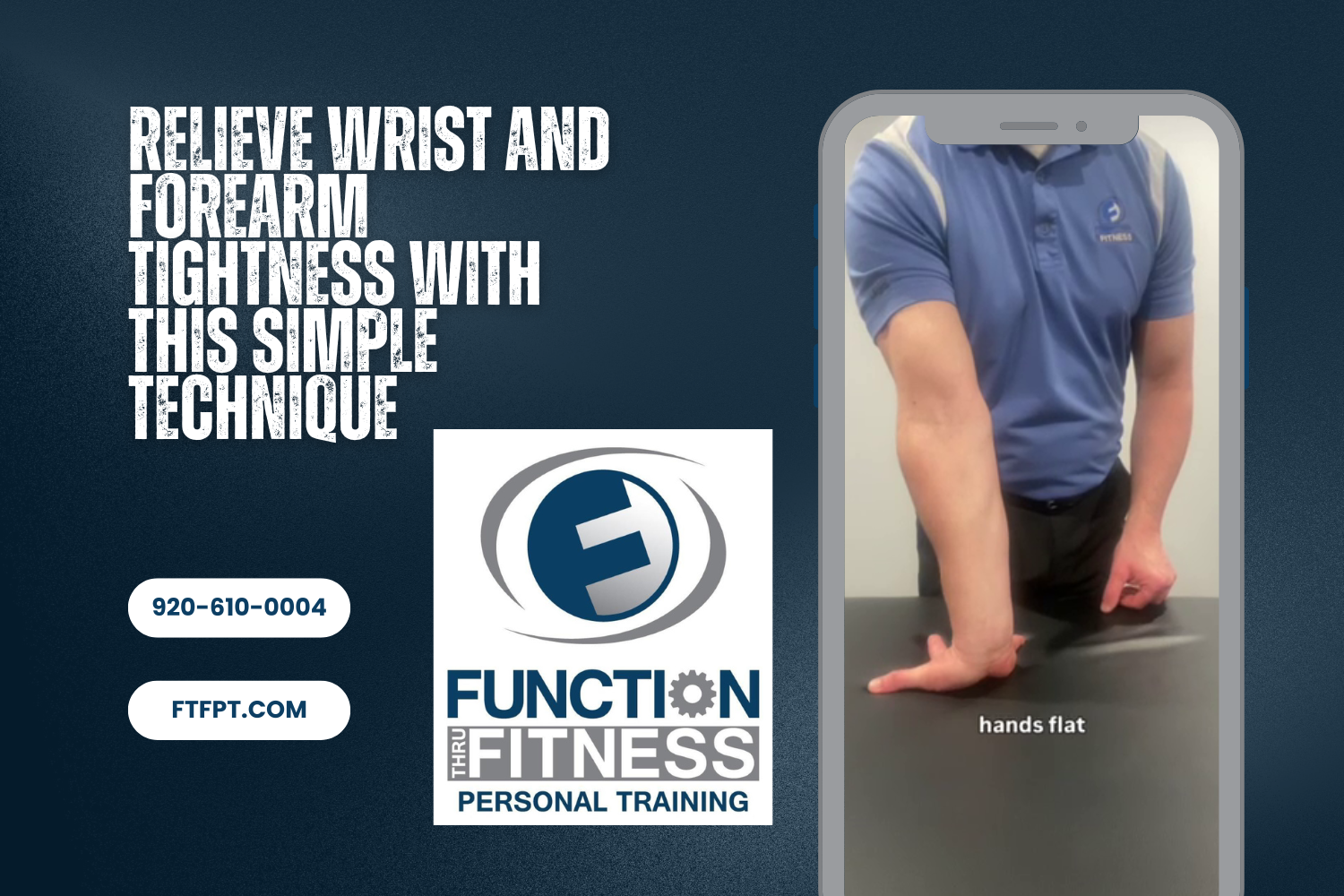
In this video, Chad Gossen, CPNMT, LMT, NASM-CPT, CES at Function Thru Fitness in Green Bay, WI demonstrates the forearm flexor stretch — a simple, no-equipment technique that takes 30 seconds per side and directly addresses one of the most overlooked sources of upper extremity discomfort. Watch the video first to see the technique in full before reading through the breakdown below.
What Are the Forearm Flexors and Why Do They Get Tight
The forearm flexors are a group of muscles that run along the underside of the forearm, from the fingers and palm through the wrist and up to the medial epicondyle — the bony prominence on the inside of the elbow. Their job is to flex the wrist and fingers, and they are engaged constantly during any activity that involves gripping, pulling, or pressing with the hands.
Because these muscles are used so frequently — in sport, in work, and in everyday tasks — they rarely get adequate recovery time. Over days and weeks, the tension accumulates. The muscles shorten and stiffen. Range of motion through the wrist decreases. And eventually the chronic load on the medial elbow becomes a source of real pain.
This is the mechanism behind golf elbow pain — also known as medial epicondylitis — which is one of the most common overuse conditions affecting golfers, racquet sport athletes, and anyone whose daily activities involve repetitive gripping. The forearm flexor stretch directly addresses this source of tension before it becomes a clinical problem, and supports recovery when it already has.
How to Perform the Forearm Flexor Stretch
Chad's demonstration is brief and precise. The technique requires no equipment and can be done anywhere.
Extend your arm. Begin with the arm extended in front of you, elbow straight. Rotate the forearm so the palm faces away from your body — fingers pointing upward or slightly downward depending on your range of motion.
Grasp the palm. Use your opposite hand to grasp across the palm. You are not pulling the fingers individually — you are using a flat grip across the palm to create an even, controlled pull.
Pull the wrist toward your body. Draw the wrist back toward you, extending through the wrist joint until you feel a stretch along the underside of the forearm. The stretch should be felt from the palm through the wrist and into the forearm. It should not be sharp or painful — it should be a clear, sustained tension that you can hold comfortably.
Hold for 30 seconds. Maintain the position for a full 30 seconds without releasing and re-gripping. Then switch arms and repeat.
The technique is straightforward, but the positioning matters. The palm must be fully facing away before you pull — not partially rotated. If the forearm is not fully supinated, the stretch changes and the flexors receive less direct lengthening. This is a common reason people do the stretch and feel little benefit.
Who Needs This Stretch
The forearm flexor stretch is relevant across a wider range of people than most realize.
Golfers are an obvious fit. The golf grip places sustained load on the forearm flexors across every swing. Over a full round — or a season — that load adds up. Golf elbow pain is the predictable result when the forearm flexors never get adequate release. Including this stretch as part of a golf flexibility training routine, both before and after play, helps manage the cumulative load and reduce the risk of developing medial epicondylitis. Golf stretching exercises recommended by trainers at the TPI level consistently include forearm flexor work for exactly this reason.
Racquet sport athletes face a similar pattern. Tennis, pickleball, and racquetball all involve repetitive gripping and wrist loading. Wrist tennis injury and forearm fatigue are direct consequences of tight, overworked flexors that never receive targeted stretching. Addressing the forearm flexors proactively is far more effective than waiting for pain to develop.
Desk workers and tradespeople are less obvious candidates but equally relevant. Typing, mouse use, tool gripping, and assembly work all require sustained forearm flexor engagement with very little corresponding stretching. The tension builds invisibly until wrist stiffness, grip discomfort, or elbow aching makes it impossible to ignore.
For older adults, the forearm flexors are part of a broader picture of upper extremity function that affects independence in daily life. Grip strength and wrist mobility directly influence the ability to open containers, carry objects, and perform fine motor tasks. Including the forearm flexor stretch among regular senior stretching exercises supports both comfort and functional capacity over time.
Fitting This Stretch Into Your Routine
The forearm flexor stretch is appropriate in several contexts. Pre-activity, it prepares the wrist and forearm for the gripping demands of golf, racquet sports, or weight training. Post-activity, it helps release the tension that accumulated during play or work before it has a chance to solidify overnight. As a daily habit, it maintains baseline flexibility in a muscle group that rarely gets a full rest day.
For golfers specifically, pairing this stretch with shoulder and hip mobility work creates a more complete pre-round routine. The hands and wrists are the final link in the kinetic chain of the golf swing, and their preparation matters as much as any other part of the body.
If wrist stiffness, forearm tightness, or golf elbow pain has been affecting your performance or your daily comfort, the forearm flexor stretch is a practical starting point. But the right approach to any persistent restriction begins with understanding what is actually driving it — and that requires a trained assessment, not just a single stretch.
Frequently Asked Question
How long should you hold a forearm flexor stretch? Hold the forearm flexor stretch for 30 seconds on each side. This duration allows the muscle to relax into the lengthened position and begin releasing chronic tension. Performing it on both sides in a single session is important for maintaining symmetry in wrist and forearm mobility.
Can tight forearm flexors cause elbow pain? Yes. The forearm flexors attach at the medial epicondyle of the elbow. When these muscles are chronically tight from repetitive gripping or wrist loading, the constant tension on the attachment site leads to inflammation and pain — the condition commonly known as golf elbow pain or medial epicondylitis. Regular forearm flexor stretching is one of the primary preventive and recovery tools for this condition.
Is the forearm flexor stretch good for golfers? The forearm flexor stretch is directly relevant for golfers. Gripping the club throughout a full round places sustained load on the forearm flexors, and without adequate recovery and stretching, this leads to tightness, reduced wrist mobility, and eventually golf elbow pain. Including this stretch in a golf flexibility training routine — before and after play — helps manage the load on the medial elbow and supports long-term playing comfort.
How do I know if my forearm flexors are too tight? Common signs include difficulty pressing the palm flat against a table or floor, restricted wrist extension range of motion, chronic tightness along the underside of the forearm, grip fatigue during normal activity, and recurring discomfort at the inside of the elbow. A functional assessment with a credentialed specialist can identify forearm flexor restriction as part of a broader upper extremity movement evaluation.
Can this stretch help with wrist pain from tennis or racquet sports? Forearm flexor tightness is a significant contributor to wrist tennis injury and racquet sport forearm fatigue. The repetitive gripping and wrist loading involved in racquet sports engages the forearm flexors extensively, and without regular stretching, the accumulated tension leads to wrist restriction and medial elbow discomfort. The forearm flexor stretch addresses this directly and fits naturally into any racquet sport warm-up or cool-down routine.
Start Moving Better
If wrist tightness, forearm discomfort, or golf elbow pain has been affecting your game or your daily life, Chad Gossen and the team at Function Thru Fitness in Green Bay, WI are here to help. Every program begins with a thorough assessment of how your body is actually moving — so the work we do together targets the real source of the problem, not just the symptom.
Book with Chad at www.ftfpt.com/chad
Looking for a better way to stay strong, mobile, and pain-free as you age?
At Function Thru Fitness, we go beyond big-box gyms. As one of the established fitness centers green bay wi, our focus is on restoring how the body moves, reducing pain, and building long-term strength through a proven function fitness approach.
We help people move better at every stage of life through personalized training, corrective exercise, golf fitness, neuromuscular therapy, and athlete recovery.
Download our free guide: Essential Exercises for Lifelong Mobility and Independence www.ftfpt.com/essential-exercises
Visit us at 801 Hoffman Rd. Suite 103, Green Bay, WI
Book online at www.ftfpt.com