
What Is a Functional Assessment?
A functional assessment is a full-body evaluation of how someone stabilizes their body during movement, not just where it hurts. At Function Thru Fitness, it combines a postural assessment, a hands-overhead squat test, and a gait analysis to identify exactly which muscles are tight, which are underactive, and how to build the most effective plan for pain-free movement.
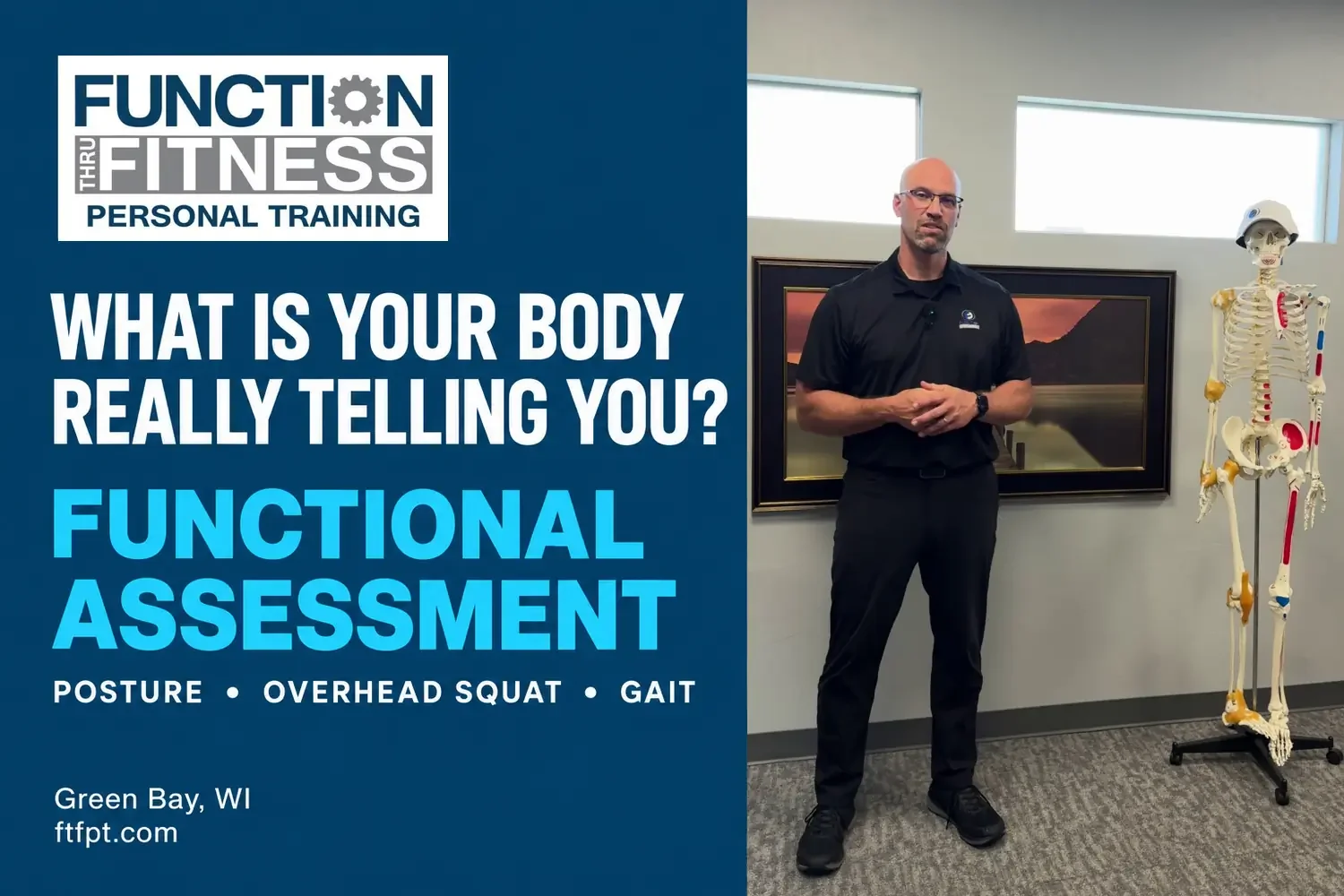
In our video, Glen Gadwood gives an overview of what a functional assessment looks like at Function Thru Fitness. Some people call it a full body alignment assessment. Glen and the team call it a functional assessment, because the goal is understanding how the body stabilizes itself with movement and what positions it holds day to day. Corrective exercise specialist Billy Jo Collette joins as the demonstration client, giving a real look at what the process actually involves for clients throughout Green Bay and the surrounding Brown County communities of Northeast Wisconsin.
The Three Parts of a Functional Assessment
A functional assessment at Function Thru Fitness is built around three pieces that, put together, give a complete picture of how someone moves.
The first is a full postural assessment. This looks at the shoulders, head, hands, hips, feet, ankles, and knees, comparing the alignment of each from one side of the body to the other. The second is a hands-overhead squat test, which is used to determine what muscles are doing their job to stabilize the joints and what muscles are tight or not functioning correctly. The third is a gait analysis, which rounds out the picture by looking at how someone moves while walking.
What a Postural Assessment Actually Looks For
The postural assessment starts at the feet and ankles. A foot that turns outward, or an arch that collapses, tells the team which muscles in the lower leg are working correctly and which ones aren't. It's common for someone to feel like their natural, turned-out foot position is normal, even when it's actually a sign of a muscular imbalance, simply because it's what feels familiar to them.
From there, the assessment follows the body up the chain, from the foot to the ankle, the knee, the hip, and beyond. Hip position matters too. If one hip sits higher than the other, that points to tight musculature pulling one side down and different musculature pulling the other side up, along with every other antagonistic muscle that isn't doing its job. Shoulder position tells a similar story. A right shoulder sitting higher than the left, for example, often means there's tension building in the neck and in the lat on the opposite side.
Looking at the body from the side reveals even more. Forward head carriage, common in people who work at a desk or spend a lot of time on their phone, usually shows up alongside neck and shoulder issues. A hip tilt that increases the arch in the low back, called lordosis, points to tight hip flexors and quads pulling the hips forward and creating compression in the low back. The team also watches for whether someone locks out their knees during the assessment, since that changes how the core and hips stabilize the body and prevents them from doing their job properly.
What the Squat Test Reveals
The hands-overhead squat test builds on what the postural assessment finds. With arms overhead, the client squats while the team watches how the body stabilizes itself from the front, the side, and behind.
If someone's arch collapses on one side, the knee on that side will often buckle inward, which is a common reason people develop knee pain without realizing the hip is the actual source of the problem. In that case, the hip isn't doing its job to stabilize the knee, and the fix involves checking for trigger points in the glute as well as strengthening it directly.
From the side, the squat test can reveal tight lats and pecs, a pattern common in people who sit at a desk all day and often develop shoulder and neck issues as a result. From behind, the team can see if the hips shift to one side during the squat. A shift to the right, for example, often means the glute medius and minimus on that side aren't stabilizing the hip correctly, which means that side needs to get stronger while the opposite side, which has been compensating and working too hard, needs to be addressed as well.
Why the Assessment Matters Before Building a Plan
None of these findings exist in isolation. A functional assessment is designed to put the postural findings, the squat test results, and the gait analysis together into one complete picture of where someone is weak, where they're tight, and how those two things are connected. That combination is what allows the team to build a plan specific to that person's body, rather than a generic program that treats everyone the same way.
This is also why the assessment comes before any corrective exercise or training plan is built. Without it, a plan is really just a guess. With it, every recommendation is tied to something the assessment actually found, whether that's strengthening an underactive glute, addressing a collapsed arch, or correcting the postural habits behind forward head carriage.
It's also why the assessment looks at the whole body rather than just the area where someone feels discomfort. A knee that hurts might actually trace back to a hip that isn't stabilizing correctly. Shoulder tension might have more to do with a forward head position than the shoulder itself. Treating only the spot that hurts, without understanding what's happening everywhere else in the chain, tends to bring temporary relief at best.
Who Benefits From a Functional Assessment
A functional assessment is useful for a wide range of people, not just those already dealing with pain. Desk workers with forward head carriage or rounded shoulders, people recovering from a past injury, athletes wanting to move more efficiently, and anyone who has noticed one side of their body working harder than the other can all benefit from understanding exactly what's happening in their movement patterns before starting a plan.
Benefits of functional assessment for chronic pain management.
For clients dealing with pain that keeps returning, a functional assessment offers something a single treatment session can't: a complete picture of why the pain keeps coming back in the first place. Rather than repeatedly loosening the same tight muscle, the assessment identifies the underactive muscle group on the other side of the pattern, along with any postural habits reinforcing it, so a corrective exercise specialist can build a plan that addresses the actual cause. That combination of identifying the cause and building a targeted strengthening plan is what turns short-term relief into long-term results for clients managing chronic or recurring pain.
Frequently Asked Questions
What is a functional assessment?
A functional assessment is a full-body evaluation of how someone's body stabilizes itself during movement. At Function Thru Fitness, it includes a postural assessment, a hands-overhead squat test, and a gait analysis to identify which muscles are tight, which are underactive, and how to build an effective, personalized plan.
What does a postural assessment check for?
A postural assessment compares the alignment of the shoulders, head, hands, hips, feet, ankles, and knees from one side of the body to the other, looking for imbalances that point to tight or underactive muscles.
What is a hands-overhead squat test?
A hands-overhead squat test has a client squat with their arms raised overhead while the assessor watches from the front, side, and back to see how the body stabilizes itself, revealing which muscles are doing their job and which ones aren't.
Where can I find expert functional assessment services near me
Function Thru Fitness offers functional assessment services in Green Bay, WI, serving Green Bay and the surrounding Brown County communities of Northeast Wisconsin. The assessment combines a postural check, a squat test, and a gait analysis to build a plan specific to your body.
How to book a functional assessment consultation with certified professionals
You can book your functional assessment at www.ftfpt.com. Your first visit starts with the assessment itself, so the plan that follows is based on exactly what your body needs.
Ready to Find Out What Your Body Is Telling You?
A functional assessment gives you a complete picture of where you're tight, where you're weak, and how to move more efficiently and pain-free. Function Thru Fitness offers this assessment in Green Bay, WI, combining a postural check, a hands-overhead squat test, and a gait analysis into one plan built specifically around your body.
Book your functional assessment at www.ftfpt.com to get started.
Visit us at 801 Hoffman Rd. Suite 103, Green Bay, WI
www.ftfpt.com | info@ftfpt.com | 920-610-0004