
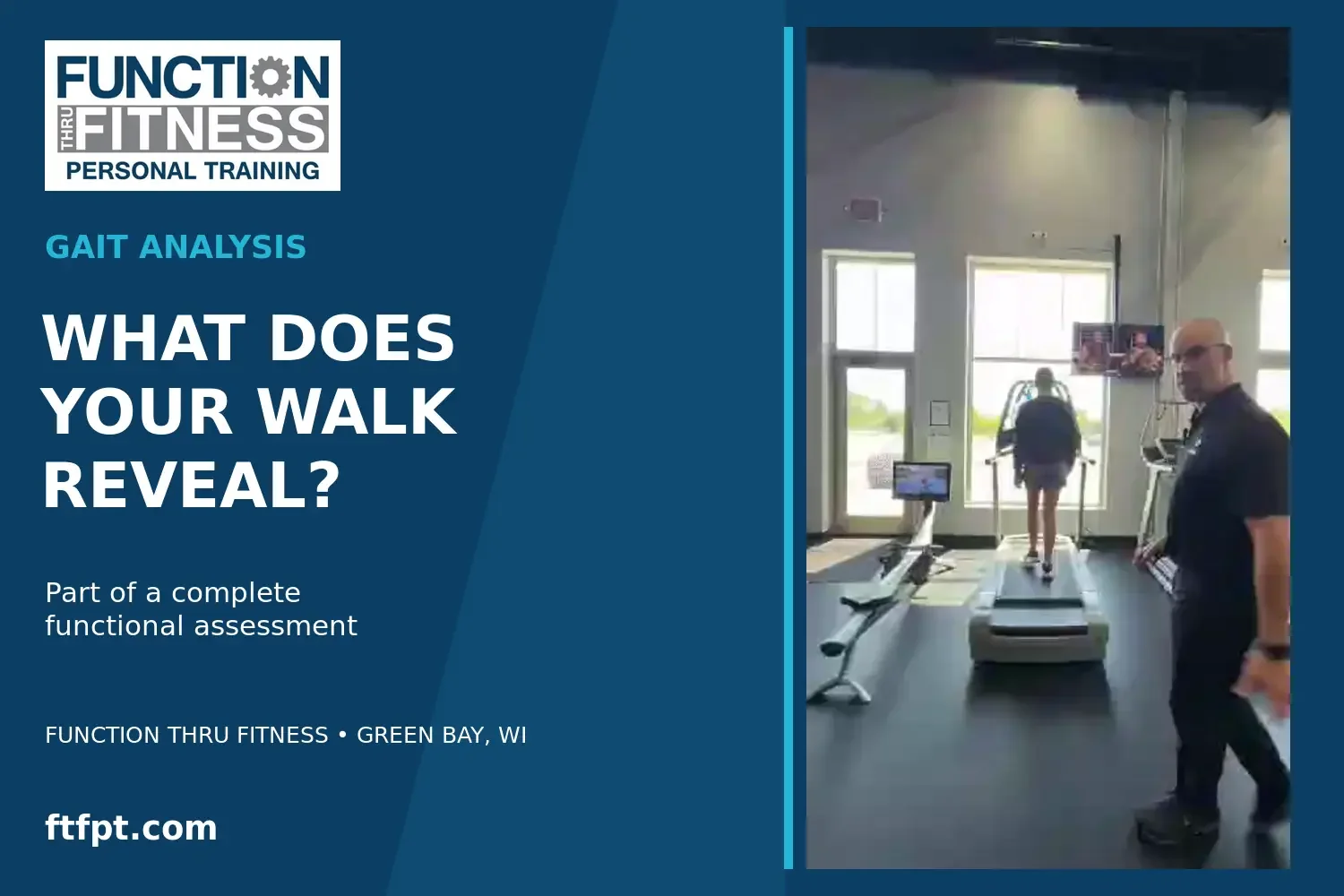
A gait analysis looks at how someone walks or runs to identify tight muscles, weak muscles, and compensation patterns that affect the whole body, not just the feet. At Function Thru Fitness, patterns like a heavy heel strike, a foot that swings outward, or a foot that crosses toward the center of the body each point to a specific muscle imbalance that can be addressed with a targeted plan.
In our video, Glen Gadwood continues where our functional assessment overview left off, walking through the gait analysis piece of the process using a treadmill assessment at Function Thru Fitness. Corrective exercise specialist Billy Jo Collette demonstrates several common patterns, giving a real look at what the team looks for with clients throughout Green Bay and the surrounding Brown County communities of Northeast Wisconsin.
A gait analysis is one of three pieces that make up a complete functional assessment, alongside a full postural assessment and a hands-overhead squat test. Where the postural assessment and squat test look at how the body holds still and stabilizes under load, the gait analysis looks at how the body moves through space, which can reveal patterns that don't show up any other way.
Why Feet Turn Out and Then In While Walking
One of the first patterns Glen points out is feet turning out slightly and then straightening as someone walks. This usually comes down to tight calves limiting dorsiflexion, the ankle's ability to lift the toe as the foot swings forward. When the calf is too tight to allow that motion, the brain compensates by turning the foot outward to avoid tripping, then bringing it back in.
This pattern is especially common in former dancers, who spend years pointing their toes downward, a position that keeps the calf in a shortened, tight position over time. Addressing it involves increasing flexibility in the calf while also building strength in the front of the shin, so the ankle can move through its full range without the foot needing to compensate.
What a Heavy Heel Strike Means
Another pattern the team watches for is a heavy heel strike, the kind loud enough to hear from across the room. Like the turned-out foot pattern, this is another telltale sign of tight calves. As soon as the heel makes contact with the ground, the tight calf causes the rest of the foot to slap down rather than roll through smoothly.
The fix follows the same principle as the turned-out foot pattern: loosen the calf and build strength in the front of the shin. Left unaddressed, this pattern can eventually lead to tripping, since the foot isn't clearing the ground the way it should during the swing phase of the stride.
Circumduction and Why It Can Cause Back Pain
A more noticeable pattern is circumduction, where the foot swings outward and then lands in front of the body instead of moving in a straight line. This typically comes from a combination of tight calves and a tight outer hamstring on the same side. The body is essentially avoiding stubbing the toe by routing the foot around and in front, which prevents a trip but changes how the whole leg moves.
What makes circumduction worth paying close attention to is that it doesn't just affect the foot and ankle. It creates extra movement at the hip level with every single step. For walkers and runners, that repeated hip-level compensation, stride after stride, is a common and often overlooked contributor to back pain. Someone dealing with back pain that seems to come out of nowhere may actually be dealing with a gait pattern that's been loading the hip and low back differently with every step for months or years.
Foot Crossing and Glute Medius Weakness
The last common pattern involves the foot crossing toward the center of the body instead of landing hip-width apart, as it would with feet moving like they're on railroad ties. This pattern usually points to weakness in the glute medius, the muscle on the side of the hip responsible for stabilizing the body each time a foot hits the ground.
When the glute medius isn't doing its job, the body compensates by shifting the landing position of the foot toward the center of the body. Addressing this pattern means specifically strengthening the glute medius so it can properly stabilize each step without the foot needing to compensate.
Looking Beyond the Feet
A gait analysis at Function Thru Fitness doesn't stop at the lower body. The team also films from the side and from the front to check for immobility in the shoulder girdle and for forward head carriage, both of which can show up in someone's gait even though they aren't foot or ankle issues at all. This is part of what makes a gait analysis such a valuable piece of a full functional assessment: it can reveal compensation patterns happening well above the feet.
How This Fits Into a Complete Functional Assessment
On its own, a gait analysis tells part of the story. Combined with a full postural assessment and a hands-overhead squat test, it becomes part of a complete functional assessment that shows exactly where someone is tight, where they're weak, and how those patterns connect across the whole body. That complete picture is what allows the team to build a plan specific to the person in front of them, rather than a generic program that treats every client the same way.
A finding from the gait analysis often confirms something the postural assessment or squat test already hinted at, or adds a new piece the other two couldn't catch on their own. A tight calf showing up during the squat test, for example, becomes much easier to understand once it's clear how that same tightness is changing the way someone's foot lands with every single step they take throughout the day.
Who Benefits From a Gait Analysis
A gait analysis is useful for more than just runners chasing better times. Anyone who walks for exercise, deals with recurring back, hip, or knee discomfort, or has a history of dance, sports, or an old injury that changed how they move can benefit from seeing exactly what their stride reveals. Former dancers and athletes in particular tend to carry old movement habits, like the toes-pointed-down pattern that tightens the calves over years of training, long after the activity itself has stopped. A corrective exercise specialist can use the gait analysis findings to build a plan that addresses those long-standing patterns directly, rather than only treating whatever area happens to be sore that week.
Frequently Asked Questions
What is a gait analysis?
A gait analysis is an evaluation of how someone walks or runs, looking for patterns like a turned-out foot, a heavy heel strike, circumduction, or a foot that crosses toward the center of the body, each of which points to a specific muscle imbalance.
Where can I get a professional running gait analysis?
Function Thru Fitness offers gait analysis as part of a complete functional assessment in Green Bay, WI, serving Green Bay and the surrounding Brown County communities of Northeast Wisconsin. The assessment identifies tight and weak muscles affecting how you walk or run, then builds a plan to address them.
Can a gait pattern really cause back pain?
Yes. Patterns like circumduction create extra movement at the hip with every step, and that repeated compensation can contribute to back pain in walkers and runners even when the low back itself was never directly injured.
Where can I find expert functional assessment services near me
Function Thru Fitness offers functional assessment services in Green Bay, WI, combining a postural assessment, a hands-overhead squat test, and a gait analysis into one complete picture of how your body moves.
How to book a functional assessment consultation with certified professionals
You can book your functional assessment at www.ftfpt.com. Your first visit starts with the assessment itself, including the gait analysis piece, so the plan that follows is based on exactly what your body needs.
Ready to Find Out What Your Walk Is Telling Us?
A gait analysis can reveal tight calves, a weak glute medius, or compensation patterns that reach all the way up to the hips and shoulders. Function Thru Fitness offers this as part of a complete functional assessment in Green Bay, WI, giving you a clear plan built around exactly how your body moves.
Visit us at 801 Hoffman Rd. Suite 103, Green Bay, WI
www.ftfpt.com | info@ftfpt.com | 920-610-0004