
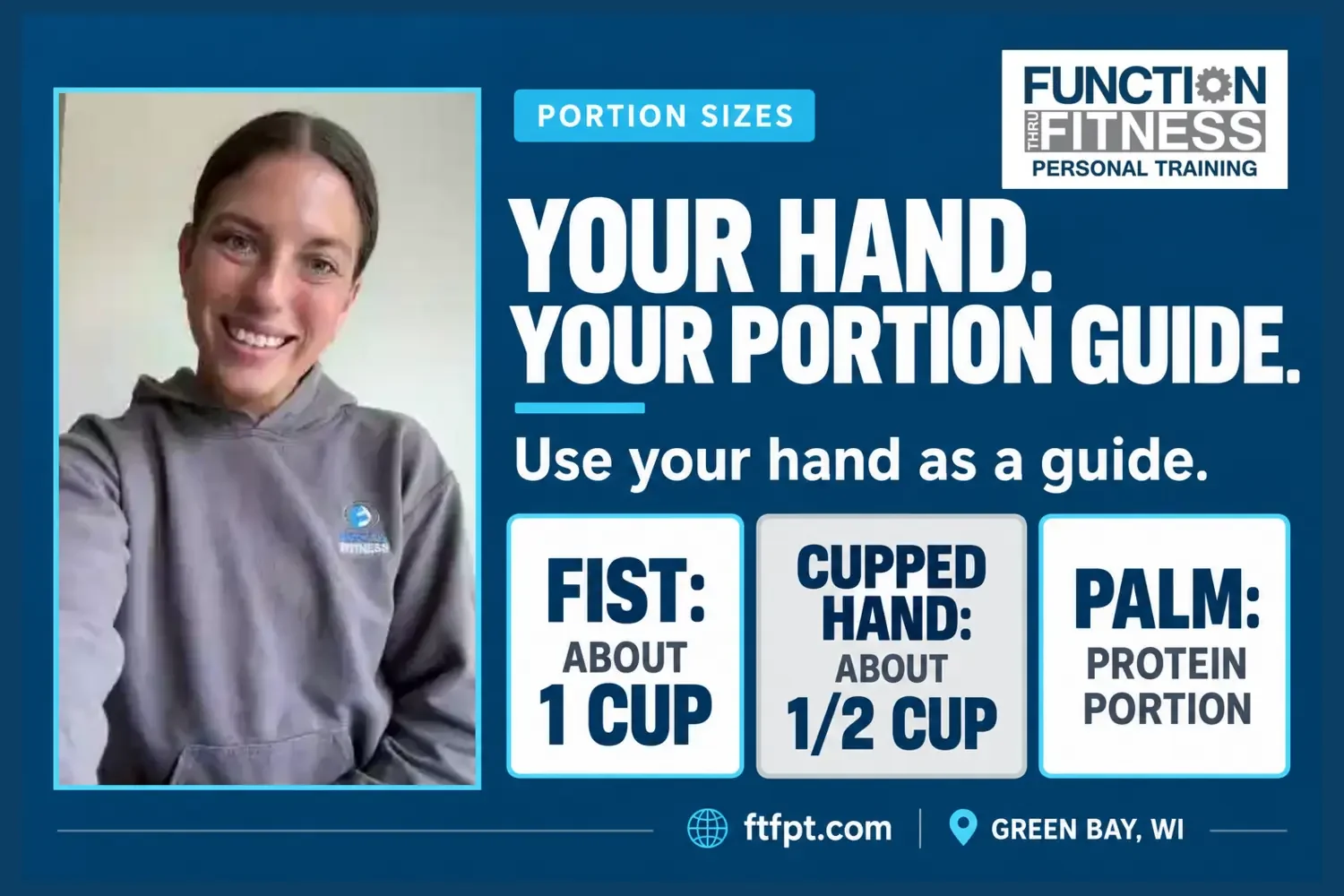
You can measure a proper portion size for rice, protein, fats, nuts, and leafy greens using nothing but your own hand as a guide. A closed fist equals about a cup, an open palm represents roughly 100 grams of protein, and a thumb's circumference measures about two tablespoons, giving you an accurate, no-equipment way to keep portions in check anywhere you're cooking.
In our video, Billy Jo Collette, nutrition coach at Function Thru Fitness, walks through a practical method clients across Green Bay and the surrounding Brown County communities of Northeast Wisconsin can use to measure portion sizes without a scale or measuring cups. The idea is straightforward: your own hand is already sized proportionally to your body, which makes it a surprisingly reliable, always-available reference for how much food actually belongs on your plate.
Why a Hand-Based Portion Guide Works
Measuring cups and food scales are accurate, but they aren't always practical. Few people bring a scale to a restaurant, a friend's house, or a work lunch. A hand-based guide solves that problem because it travels with you everywhere. It also scales naturally to the individual, since a larger hand generally corresponds to a larger body and higher caloric needs, making it a more personalized reference than a fixed, one-size-fits-all measurement.
Rice, Fruit, and Vegetables: A Closed Fist
A closed fist is about a cup, which is the appropriate serving size for rice, fruit, or vegetables on your plate. This is one of the easiest reference points to remember, since it applies to several of the most common foods people are trying to portion correctly at a typical meal.
Fats and Oils: Fingertip to First Knuckle
For any fat or oil added to a pan while cooking, the right serving size is roughly what fits from the tip of your finger to the first knuckle. Fats and oils are calorie-dense, so even small differences in serving size can add up quickly, which makes this small, precise measurement particularly useful in the kitchen.
Nuts and Dried Fruit: A Cupped Palm
The part of your palm that curls into a small circle when cupped represents about half a cup, the right serving size for nuts or dried fruit. Like fats and oils, nuts and dried fruit are calorie-dense in small volumes, so this measurement helps prevent portions from creeping larger than intended.
Leafy Greens: Two Handfuls
For fresh leafy greens in a salad, the right amount is two handfuls, meaning both hands cupped together and filled once. Because leafy greens are low in calories and high in volume, this is a more generous portion than some of the other guidelines, which reflects how much of your plate leafy greens can reasonably fill.
Protein: An Open, Stretched Palm
Stretching your palm out wide and looking at its full circumference gives you a serving size of roughly 100 grams of protein, the amount that should be on your plate at a typical meal. For anyone eating a vegan protein source, Billy Jo recommends doubling that portion, since plant-based proteins are often less calorie-dense and less complete per serving than animal protein sources.
Cheese and Peanut Butter: A Thumb's Circumference
The last measurement uses the circumference of your thumb, from base to tip, all the way around, which measures about two tablespoons. This is the appropriate serving size for cheese or peanut butter, two foods that are easy to over-portion because they're calorie-dense but don't take up much visual space on a plate.
Putting It All Together on Your Plate
Once each measurement is familiar on its own, the real value comes from combining them into a full meal. A typical plate built with this method might include a fist-sized portion of rice or another starch, an open-palm portion of protein, and however much room is left filled with vegetables, using the same fist measurement as a reference point for those as well. A meal like a salad would follow a slightly different pattern, built around two handfuls of leafy greens, an open-palm portion of protein on top, and a fingertip-to-first-knuckle amount of oil or dressing.
This kind of visual, hand-based approach also makes it easier to build balanced meals on the fly, whether that's packing a lunch, ordering at a restaurant, or serving dinner at home. Instead of needing to look up a recipe's exact measurements or reach for a scale, the reference is already built into your hand, which means it works just as well in a kitchen as it does anywhere else.
Why a Practical Tool Like This Matters for Long-Term Habits
A lot of nutrition advice fails not because it's inaccurate, but because it's too difficult to maintain consistently. Weighing and measuring every meal is precise, but it's also a habit that tends to fall away over time, especially for anyone balancing a busy schedule, travel, or eating outside the home regularly. A hand-based portion guide solves that problem by being practical enough to use anywhere, without any equipment, which makes it far more likely to actually stick as a long-term habit rather than something used for a few weeks and then abandoned.
That kind of sustainability is a core part of how nutrition coaching works at Function Thru Fitness. Rather than handing a client a rigid meal plan built entirely around exact gram counts, the goal is to build tools and habits a client can realistically maintain, whether their focus is weight management, supporting an active training schedule, or simply eating more consistently well day to day.
Who This Approach Works Well For
A hand-based portion guide is useful for a wide range of people, not just those following a specific weight loss plan. Busy professionals who eat out often or don't have time to weigh meals, athletes and active clients trying to match protein intake to training demands, and anyone newer to nutrition coaching who wants an approachable starting point before diving into more detailed tracking can all benefit from a method this practical. It's also a useful tool within the women's health and wellness services Billy Jo offers, where nutrition often plays a role alongside training and lifestyle support.
How This Fits Into Nutrition Coaching at Function Thru Fitness
A hand-based portion guide is a helpful starting point, but it's just one piece of a complete approach to nutrition. Billy Jo offers personalized nutrition coaching for clients working toward a range of goals, including weight management, athletic performance, and general health, building on foundational tools like this one with a plan tailored to each client's specific needs, activity level, and preferences.
Frequently Asked Questions
How can I measure portion sizes without a scale or measuring cups?
You can use your own hand as a guide. A closed fist measures about a cup for rice, fruit, or vegetables, a fingertip to the first knuckle measures a serving of fat or oil, a cupped palm measures about half a cup for nuts or dried fruit, two handfuls measures a serving of leafy greens, an open stretched palm represents about 100 grams of protein, and a thumb's circumference measures about two tablespoons for cheese or peanut butter.
Why does a vegan protein portion need to be doubled?
Plant-based protein sources are generally less calorie-dense and contain less protein per serving than animal-based sources, so doubling the portion helps ensure you're getting a comparable amount of protein at the meal.
How to choose a certified nutrition coach
Look for a certified nutrition coach who takes a personalized approach rather than a one-size-fits-all plan, and who can explain practical, everyday tools, like a hand-based portion guide, alongside a longer-term nutrition strategy tailored to your goals.
Find a local specialist for customized meal planning.
Function Thru Fitness offers customized meal planning and nutrition coaching in Green Bay, WI, with nutrition coach Billy Jo Collette building personalized plans for clients across Green Bay and the surrounding Brown County communities of Northeast Wisconsin.
Benefits of working with a dedicated food and lifestyle expert.
Working with a dedicated food and lifestyle expert means getting guidance built around your actual habits, schedule, and goals rather than a generic template, along with practical tools, like portion guidance you can use anywhere, that make healthy choices easier to sustain long-term.
Ready to Build a Nutrition Plan That's Actually Yours?
A hand-based portion guide is a helpful starting point, but a personalized nutrition plan takes things further. Billy Jo Collette offers nutrition coaching at Function Thru Fitness in Green Bay, WI, built around your goals, your schedule, and your everyday life.
Book with Billy Jo at www.ftfpt.com/billyjo to get started.
Visit us at 801 Hoffman Rd. Suite 103, Green Bay, WI
www.ftfpt.com | info@ftfpt.com | 920-610-0004