
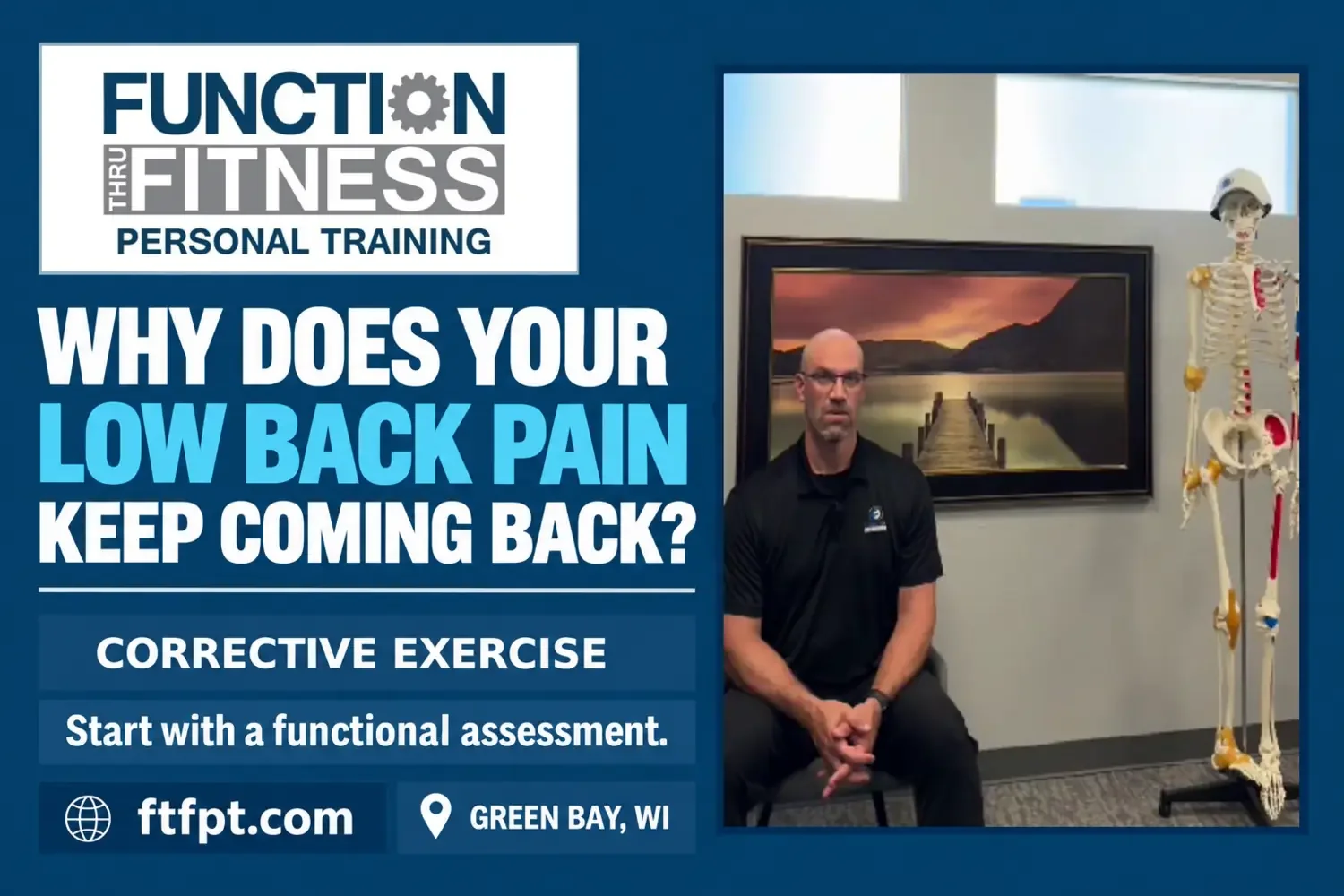
Low back pain often returns after massage or neuromuscular therapy because soft tissue work only addresses the tight, overworked muscle, not the underactive antagonistic muscle group behind it. A corrective exercise specialist identifies that compensation pattern through assessment, then builds a plan to strengthen the weak side so the imbalance, and the pain, don't come back.
In our video, Glen Gadwood, owner of Function Thru Fitness, answers one of the most common questions his team hears: why does someone's low back pain return after massage or NMT already eliminated it? For clients across Green Bay and the surrounding Brown County communities of Northeast Wisconsin, this pattern is familiar. The pain goes away for a while, then quietly creeps back in.
Glen explains that there are many different causes of low back pain, but one of the most common is a compensation pattern that developed from the mechanics of day-to-day life or a prior injury. These patterns cause certain muscles to overwork while other muscles become underactive or weak, and that imbalance is often what's really behind the pain.
The Real Reason Pain Comes Back After Soft Tissue Work
Massage, NMT, and myofascial release and trigger point therapy are genuinely effective at loosening a tight muscle, a trigger point, or a knot. That relief is real, and it's an important part of addressing pain. But Glen points to what's missing when the pain keeps returning: the antagonistic muscle group, the muscle that does the exact opposite job of the one that's tight, isn't functioning the way it should.
When that underactive muscle never gets addressed, the tight muscle simply takes back over. It has to, because nothing else in the system is doing its share of the work. This is why loosening up the same tight spot over and over can feel like chasing the same pain in a loop rather than actually resolving it.
Why Corrective Exercise Has to Be Part of the Plan
For clients dealing with this pattern, Glen is clear that they need to add in corrective exercise that specifically addresses the compensation pattern and the underactive muscles, not just the tight ones. Loosening a muscle, a trigger point, or a knot can bring short-term relief, but if the underlying cause is never corrected, the pain has a clear path back.
That underlying cause is often something ordinary: poor posture held for hours at a desk, repetitive use of one arm more than the other, or favoring one leg over the other during everyday movement. Glen is direct about what happens if that cause is never addressed: you'll always be spinning your wheels in terms of getting someone better, because the pain will always come back if the cause was never treated in the first place.
How an Assessment at Function Thru Fitness Identifies the Cause
This is exactly what a functional assessment is designed to catch. At Function Thru Fitness, an assessment doesn't stop at identifying where it hurts. It looks at the whole movement pattern to determine why the pain developed, then addresses the cause as well as the symptom.
Clients leave the assessment with a big-picture analysis: which muscles will be treated directly, and which ones need to be strengthened on an ongoing basis to keep the issue from resurfacing. That second part, the strengthening plan for the underactive muscles, is what keeps the problem from becoming a recurring cycle of temporary relief followed by pain returning weeks or months later.
Who This Applies To
This pattern isn't limited to one type of client. Anyone who has had a tight, painful area loosened up through massage, NMT, or general stretching, only to feel it return, is a candidate for this kind of assessment. That includes desk workers dealing with postural compensation from long hours sitting, people recovering from an old injury that never fully resolved, athletes whose training favors certain movement patterns over others, and anyone whose day-to-day habits, from carrying a bag on one shoulder to standing with more weight on one leg, favor one side of the body over the other.
The pattern behind the pain is the same even when the daily cause looks different from person to person, which is exactly why a one-size-fits-all stretching routine rarely solves it. The compensation pattern has to be identified first, specific to that individual's body and habits, before a corrective exercise plan can actually address it.
What to expect during a corrective exercise consultation
A corrective exercise consultation at Function Thru Fitness starts with a conversation about the pain pattern itself: where it shows up, when it started, and what has and hasn't provided relief in the past, including any prior massage, NMT, or physical therapy. From there, the assessment moves into movement testing designed to reveal compensation patterns, checking how different muscle groups are working together, or failing to, across the affected area.
Rather than walking away with a generic stretching handout, clients leave with a specific breakdown: which muscles are overworked and tight, which ones are underactive and need to be strengthened, and what the corrective exercise plan looks like to address both sides. This is also where the ongoing NMT or soft tissue work, when appropriate, gets paired with a strengthening plan instead of being used as a standalone fix. The goal of the consultation is always the same: leave with a clear picture of the actual cause, not just a list of exercises to try.
Why This Matters for Long-Term Results
Addressing only the tight side of a compensation pattern will always produce the same result: temporary relief followed by pain that returns. Addressing both sides, loosening what's overworked and strengthening what's underactive, is what actually keeps the issue away long-term. That combination is central to how Function Thru Fitness approaches corrective exercise and functional assessment for clients dealing with low back pain and similar recurring issues.
It's also why a single visit rarely tells the whole story. The first assessment identifies the pattern, but the strengthening side of the plan takes consistent follow-through to actually change how the underactive muscle group functions day to day. Clients who stick with that plan are the ones who see the pain stay away, rather than returning every few weeks like clockwork.
Frequently Asked Questions
Why does low back pain come back after massage or NMT worked at first?
Massage and NMT loosen the tight, overworked muscle causing pain, which brings real relief. But if the antagonistic muscle group on the other side is underactive and never addressed, the tight muscle takes back over and the pain returns. Long-term relief requires addressing both sides of the compensation pattern.
What is a corrective exercise specialist
A corrective exercise specialist identifies compensation patterns in the body, the combination of overworked and underactive muscles that develop from daily mechanics or a past injury, and builds a plan to correct them rather than only treating the symptom.
How to choose a corrective exercise specialist near me?
Look for a corrective exercise specialist who starts with a full movement assessment rather than a generic workout, identifies both the overworked and underactive muscles behind your pain, and gives you a clear, specific strengthening plan rather than a one-size-fits-all stretching routine.
Importance of movement assessment in corrective exercise
A movement assessment is what allows a corrective exercise specialist to identify the actual cause of pain, the specific compensation pattern and underactive muscles involved, rather than guessing based on where the discomfort is felt.
Where to find clinics specializing in musculoskeletal pain assessment nearby
Function Thru Fitness offers musculoskeletal pain assessment in Green Bay, WI, serving Green Bay and the surrounding Brown County communities of Northeast Wisconsin. Glen Gadwood, CPNMT, LMT, BCTMB, NASM-CES, leads assessments designed to identify the true cause of recurring pain before building a corrective plan.
Ready to Stop Your Low Back Pain From Coming Back?
If massage or NMT has helped your low back pain before, only to have it return, the missing piece is likely an underactive muscle group that was never addressed. Glen Gadwood, CPNMT, LMT, BCTMB, NASM-CES, owner of Function Thru Fitness, offers assessments in Green Bay, WI, built to identify the compensation pattern behind recurring pain and correct it for good.
Book with Glen Gadwood at www.ftfpt.com/glen. Your first visit starts with a functional assessment to find out what's really going on.
Visit us at 801 Hoffman Rd. Suite 103, Green Bay, WI
www.ftfpt.com | info@ftfpt.com | 920-610-0004