
Single Leg Box Step Up: How to Do It Right and How to Progress It
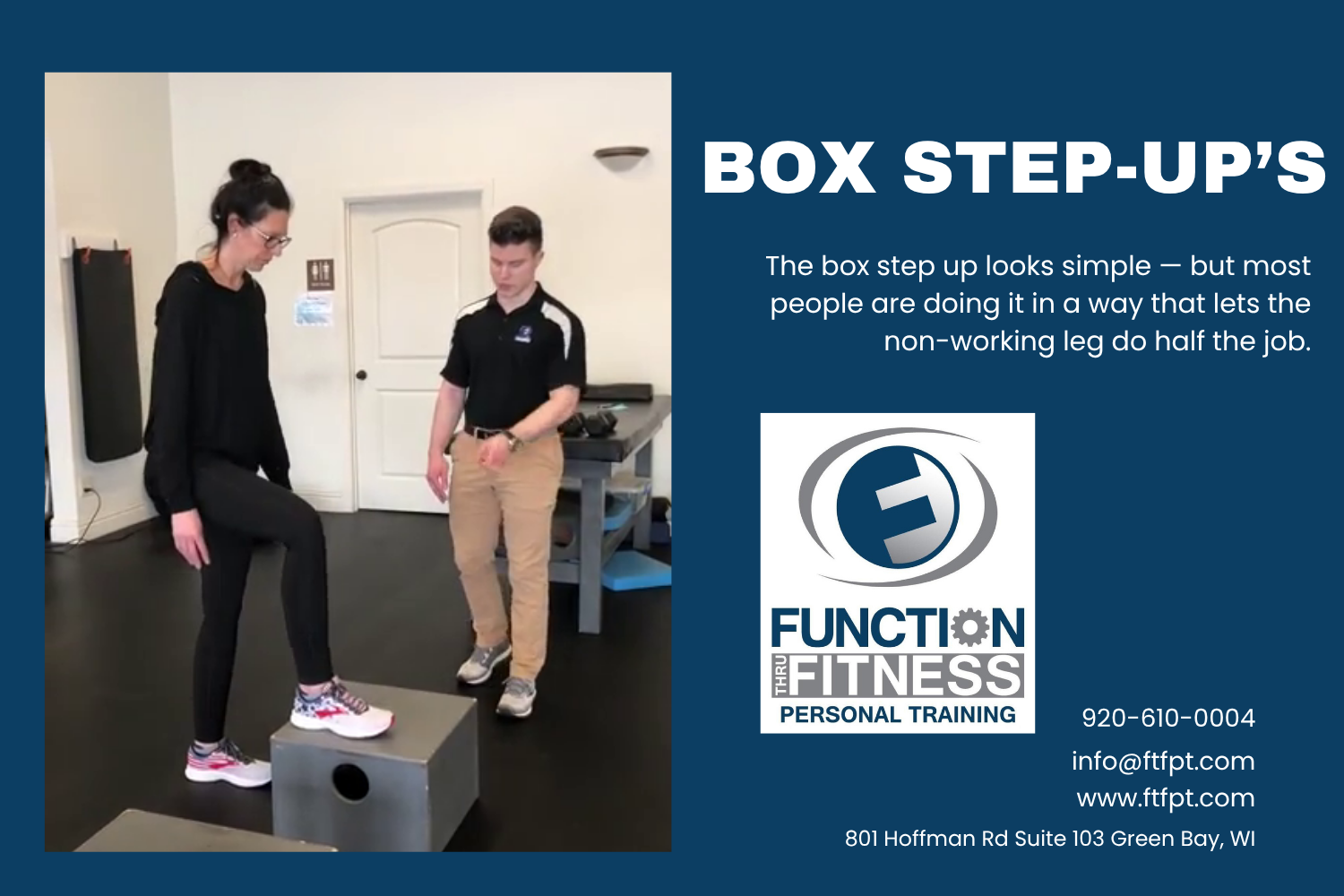
The box step up is one of the most commonly programmed lower body exercises in personal training — and one of the most commonly performed with a technique error that quietly removes most of its benefit. In this video, John Blaser, NASM-CPT, NASM-CES, NASM-FNS, CBS at Function Thru Fitness in Green Bay, WI walks through the single leg box step up with the cues that make it an effective functional strength and balance exercise, and outlines three clear progression variables for when it becomes too easy.
The Most Common Error in the Box Step Up
The single most common mistake in the single leg box step up is letting the non-working foot touch down at the bottom of the descent. It happens naturally — the body looks for the path of least resistance, and allowing the trailing foot to briefly contact the floor provides a small but meaningful assist to the working leg.
The problem is that this assist is exactly what the exercise is designed to eliminate. A single leg box step up is built around the demand of one leg doing all the work through the full range of motion — the ascent and the controlled descent. The moment the non-working foot contributes, the working leg gets a break and the training stimulus is reduced.
The correction is straightforward: the non-working foot stays off the floor through the entire movement. The working leg is responsible for controlling the descent all the way down, and the non-working foot does not make contact until the set is complete or the foot is deliberately placed for the next repetition.
This is a corrective exercise principle applied to a common strength movement — using precise cuing to ensure the intended muscles are doing the intended work.
How to Perform the Single Leg Box Step Up
The setup is simple. Place one foot fully on the box and drive through that working leg to stand. The ascent should be deliberate and controlled — not a momentum-driven push from the floor.
The descent is where most of the training value lives. Lower slowly and under control through the working leg, keeping the non-working foot off the floor until the bottom of the movement. A slow, controlled eccentric — the lowering phase — builds strength and stability in the glute and quad in a way that a fast or assisted descent does not.
Posture holds throughout every repetition. Chest up, shoulder blades back, and eyes forward. Allowing the chest to drop or the shoulders to round forward shifts the load pattern and reduces the quality of the movement.
Why Single-Leg Strength and Balance Matter
The single leg box step up builds glute and quad strength in a functional, single-leg loaded pattern — meaning the body is trained in a way that mirrors how it actually moves. Walking, stair climbing, getting up from a seated position, and most athletic movements involve one leg bearing load at a time. Training that pattern directly produces strength that transfers.
For older adults, this makes the single leg box step up one of the more practical senior exercises for balance and lower body strength. Improving the capacity to control body weight on one leg — through the full range of a step — has direct carryover to stair navigation, fall prevention, and the kind of daily movement demands that require single-leg stability and control.
For active adults and athletes, single-leg strength addresses asymmetries, builds hip and knee stability, and develops the eccentric control that protects joints during athletic activity.
Three Ways to Progress the Exercise
When the single leg box step up becomes manageable at a given level, John outlines three variables to increase the challenge.
Box height. A higher box increases the range of motion through which the working leg must control the movement. As box height increases, the demand on the glute and quad increases through a longer range, and the balance challenge at the top of the step becomes more pronounced. Start at a height that allows clean technique throughout, and increase only when the current height can be performed with full control and posture.
Added resistance. Holding dumbbells or a weight in the hands increases the load the working leg must manage through the full range. The posture cues become more important as load increases — chest up, shoulder blades back, and the non-working foot staying off the floor remain non-negotiable regardless of how much weight is added.
Metronome tempo. Introducing a metronome to control the pace of the movement adds a time under tension variable that changes the character of the exercise without requiring more equipment or a higher box. A slower tempo forces the working leg to manage the eccentric descent over a longer period, significantly increasing the strength and stability demand on the glute and quad.
These three variables can be combined or used independently depending on the training goal and the current capacity of the individual.
Functional Strength Training at Function Thru Fitness
At Function Thru Fitness in Green Bay, WI, exercises like the single leg box step up are integrated into personal training programs because they produce functional fitness outcomes — strength and stability that carry into how the body moves outside the gym. Every movement is selected and coached with a clear purpose, and progressions are structured around what each individual's body is actually ready for.
If you are looking for personal trainers in green bay wi who program single-leg strength, balance, and corrective exercise with this level of detail, our team is here.
Watch the Full Video
Located in Green Bay, WI, we offer by-appointment-only consultations and Functional Movement Assessments designed to help you move better, breathe easier, and live with less pain.
Want to experience this for yourself?
FAQ’s
What muscles does a single leg box step up work? The single leg box step up primarily targets the glute and quad of the working leg. The gluteus maximus and gluteus medius are engaged through the drive phase and hip stabilization, while the quadriceps control the descent and generate force on the ascent. The core engages throughout to maintain posture and stability.
Why should the non-working foot not touch the floor during a box step up? The non-working foot touching the floor provides an assist to the working leg, reducing the training stimulus. The single leg box step up is designed to challenge one leg through the full range of motion — ascent and controlled descent — without assistance. Keeping the non-working foot off the floor ensures the working leg is responsible for the entire movement.
How do you progress the single leg box step up? Three progression variables are available: increase the height of the box to increase range of motion demand, add resistance through dumbbells or weights to increase the load on the working leg, and introduce a metronome to control tempo and increase time under tension during the descent.
Is the single leg box step up appropriate for seniors? Yes. The single leg box step up is one of the more practical senior exercises for balance and lower body strength when performed at an appropriate box height with controlled technique. The movement builds the single-leg stability and quad and glute strength that transfer directly into stair navigation, fall prevention, and daily movement demands.
How does functional fitness training differ from standard gym workouts? Functional fitness training focuses on movement patterns the body uses in daily life, sport, and recreational activity — such as single-leg loading, balance, and controlled eccentric strength — rather than isolated muscle group exercises. At Function Thru Fitness in Green Bay, WI, personal training programs are built around functional movement patterns because the outcomes transfer more directly into how clients actually live and move.
Looking for a better way to stay strong, mobile, and pain-free as you age?
At Function Thru Fitness, we go beyond big-box gyms. As one of the established fitness centers green bay wi, our focus is on restoring how the body moves, reducing pain, and building long-term strength through a proven function fitness approach.
We help people move better at every stage of life through personalized training, corrective exercise, golf fitness, neuromuscular therapy, and athlete recovery.
Download our free guide:
Essential Exercises for Lifelong Mobility and Independence
www.ftfpt.com/essential-exercises
Visit us at 801 Hoffman Rd. Suite 103, Green Bay, WI
Book online at www.ftfpt.com