
Banded and Cable Core Rotation: How to Build Rotational Core Strength the Right Way
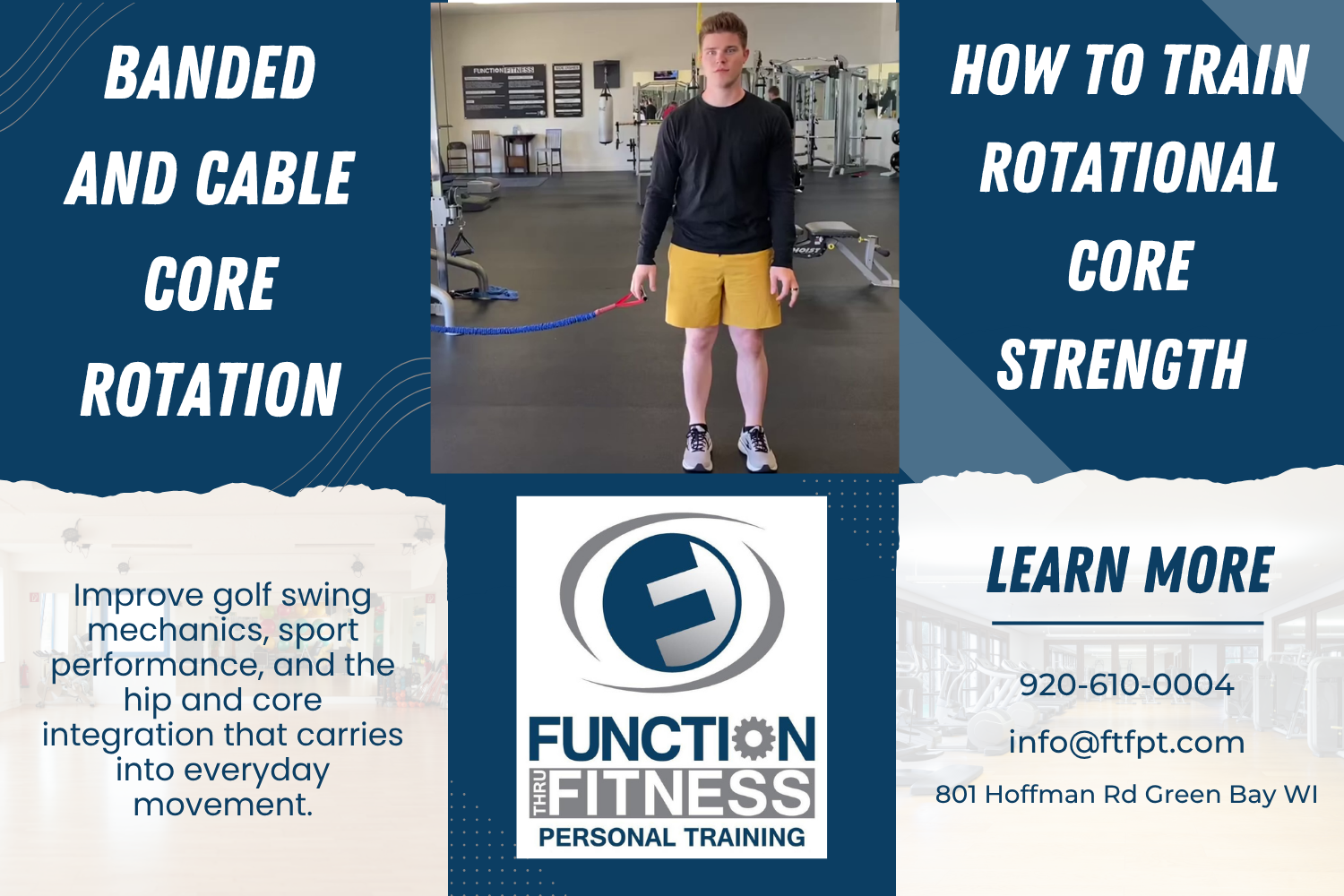
Rotational core strength is one of the most functional qualities a training program can develop — and one of the most consistently absent from standard core exercise routines. Crunches, planks, and floor-based abdominal work develop anterior core stability in a single plane of motion. Rotational exercises like the banded and cable core rotation train the core in the transverse plane — the plane in which the body generates and transfers force during athletic movement, golf, sport, and a wide range of daily activities.
In this video, John Blaser, NASM-CPT, NASM-CES, NASM-FNS, CBS at Function Thru Fitness in Green Bay, WI demonstrates both the banded and cable versions with complete setup and technique detail — including the cue most people miss on the return.
Why Rotational Core Strength Matters
The ability to generate and control rotation through the trunk and hips is foundational to athletic performance, sport-specific movement, and functional daily capacity. Golf hip rotation is the most direct application — the golf swing is fundamentally a rotational movement, and the power, consistency, and safety of that swing depend on the body's ability to rotate efficiently through the hips and core while maintaining a stable base.
But the application extends beyond golf. Picking something up off the floor while turning, reaching across the body while carrying load, changing direction during recreational sport — all of these involve rotational demands that isolated anterior core training does not prepare the body for.
For older adults, rotational core strength is also a meaningful component of senior exercises for core strength that preserve functional movement patterns — particularly the hip and trunk coordination needed for safe, efficient daily movement and fall prevention.
Athletic Stance: The Foundation
Before the first repetition, the stance establishes everything. Feet are hip-width apart, toes pointing straight ahead, and the knees are in line with the toes with a slight bend. The pelvis is in a neutral position — not anteriorly tilted, not tucked excessively.
Ground through the outside foot — the foot furthest from the resistance — and engage the abs. This grounding creates the stable base the rotation works against. Without it, the rotation is driven by momentum rather than muscular control, and the training effect is reduced.
The Movement: One Unit, 45 Degrees
Extend the arms and rotate approximately 45 degrees away from the resistance source. The critical cue is that the whole body moves as one unit. The rotation is not driven by the arms pulling independently or the trunk twisting in isolation — the hips, core, and upper body rotate together through the movement.
As the rotation occurs, the hip on the opposite side engages. Rotating to the left creates engagement in the right hip. This hip integration is not incidental — it is the mechanism through which force is transferred through the kinetic chain during rotation. Training the body to include that hip engagement in a bracing core exercise pattern directly improves the quality of the same integration in athletic movement and in the golf swing.
The Return: Slow and Controlled
The return to the midline is where most people lose the training value of this exercise. Allowing the resistance to pull the body back quickly turns the return into a passive movement rather than a controlled eccentric. The rotational muscles stop working, and the exercise becomes a concentric-only drill that trains half of what it is capable of training.
The return should be as deliberate as the rotation — a controlled, slow movement back to the midline that maintains muscular engagement throughout. This is the detail that separates an effective rotational core exercise from one that goes through the motions.
Cable Variation: Setup and Weight Selection
For the cable version, set the attachment at the midpoint between the navel and the sternum — roughly in the center of the body. This height positions the pull in a way that loads the rotational pattern most effectively without biasing upward or downward through the trunk.
Extend the arms and allow the head to lead the rotation. The same principles apply: one unit, 45 degrees, controlled return. Select a weight that allows 15 clean reps per side with full control throughout the movement. Form determines the appropriate load — do not increase weight to the point that the controlled return is compromised.
Band vs. Cable: Choosing Based on Equipment
Both the band and cable versions train the same movement pattern with the same cues. The band version is accessible anywhere and provides a tension profile that increases toward the end range of the rotation. The cable version provides more consistent tension throughout the full range and allows more precise weight selection. Both are effective — the choice is based on what is available and which variation feels most controlled for the individual.
Applications at Function Thru Fitness
At Function Thru Fitness in Green Bay, WI, core rotation exercises like this appear in personal training programs across populations. For golfers, this movement directly trains the golf hip rotation and rotational core integration that drive swing performance — and is part of the TPI Golf fitness approach our team uses with golfers working on physical performance alongside their technical game.
For athletes and active adults, it builds the functional rotational capacity that translates into sport and recreational movement. And as a senior exercises for core strength movement, it preserves the rotational patterns that daily life and fall prevention depend on.
Watch the Full Video
FAQ’s
What does a banded or cable core rotation exercise train? The banded and cable core rotation trains rotational core strength in the transverse plane — the plane in which the body generates and transfers force during athletic movement, golf, sport, and functional daily activities. It develops the integration of the hips, trunk, and upper body during rotation, which standard anterior core exercises do not address.
Why should the whole body move as one unit during a core rotation? Moving the whole body as one unit ensures that the rotation is driven by the core and hips working together rather than the arms pulling independently or the trunk twisting in isolation. This integrated movement pattern is how the body actually uses rotation in athletic and functional contexts — training it as a unit builds the same coordination the body needs in real movement.
What is the correct setup for the cable version of a core rotation? Set the cable attachment at the midpoint between the navel and the sternum — approximately the center of the body. This height loads the rotational pattern effectively without biasing the pull too high or too low through the trunk. Extend the arms, allow the head to lead the rotation, and select a weight that allows 15 controlled reps per side with a slow return to the midline.
How does core rotation training help with golf hip rotation? The golf swing is fundamentally a rotational movement that depends on the hips, core, and upper body working together through the transverse plane. Core rotation exercises like this banded and cable variation train the same hip and trunk integration the swing requires — building the rotational strength and coordination that drive power and consistency on the course while reducing the injury risk associated with poor rotational mechanics.
Is core rotation training appropriate for seniors? Yes. Rotational core strength is an important component of functional movement at every age. As one of the senior exercises for core strength that develops and preserves the hip and trunk coordination needed for daily movement patterns, the banded or cable core rotation can be scaled to appropriate resistance and range of motion for older adults building functional rotational capacity.
Looking for a better way to stay strong, mobile, and pain-free as you age?
At Function Thru Fitness, we go beyond big-box gyms. As one of the established fitness centers green bay wi, our focus is on restoring how the body moves, reducing pain, and building long-term strength through a proven function fitness approach.
We help people move better at every stage of life through personalized training, corrective exercise, golf fitness, neuromuscular therapy, and athlete recovery.
Download our free guide: Essential Exercises for Lifelong Mobility and Independence www.ftfpt.com/essential-exercises
Visit us at 801 Hoffman Rd. Suite 103, Green Bay, WI Book online at www.ftfpt.com