
How to Breathe Into the Back of Your Body: A Corrective Exercise for Posterior Ribcage Expansion
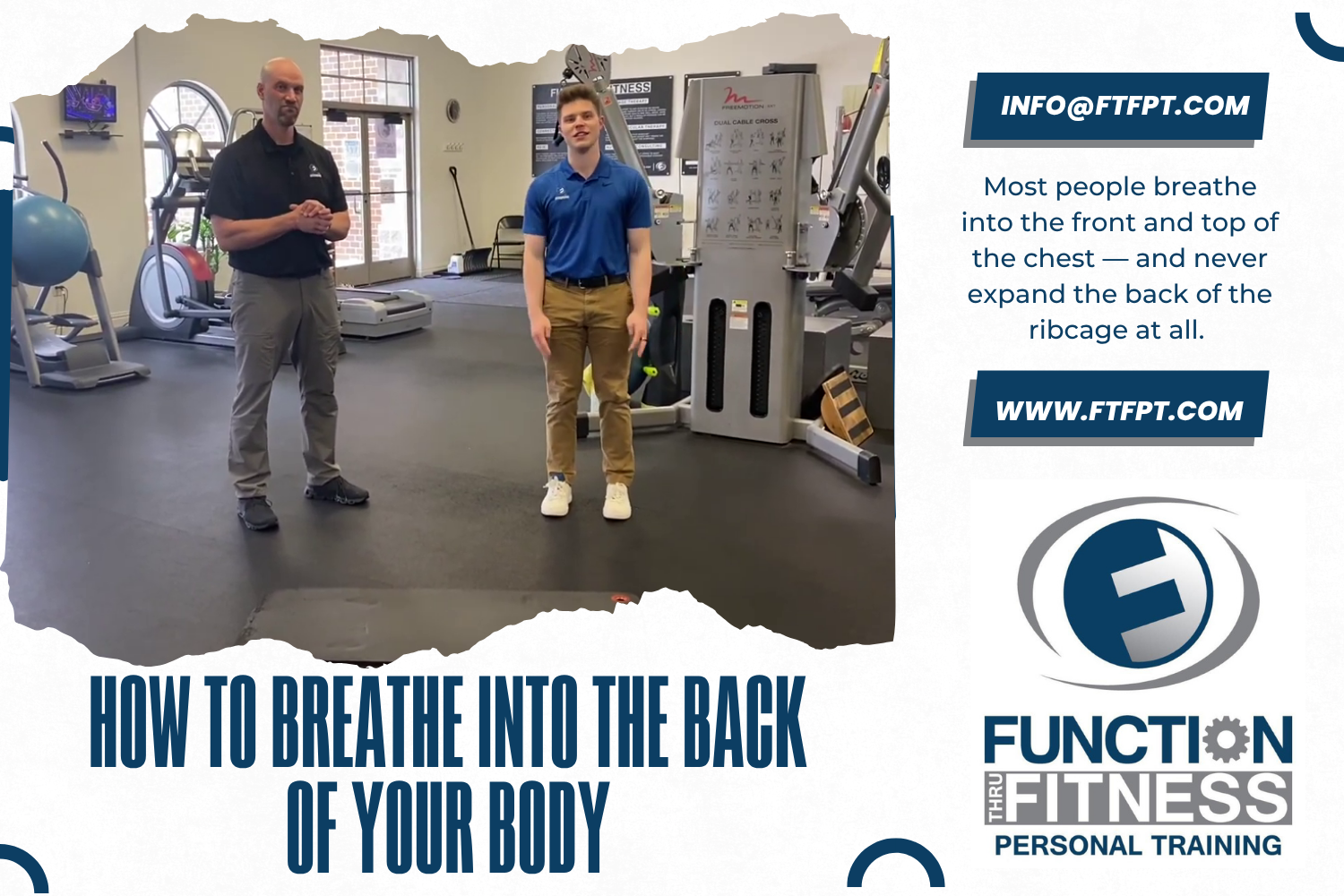
Most people have never deliberately directed air into the back of their body — and that limitation has consequences that extend well beyond breathing. When the posterior ribcage is compressed and tight, the ribcage flattens. A flattened ribcage prevents the shoulder blades from gliding and moving efficiently around it. Shoulder mobility decreases, upper back tension increases, and the kyphotic forward posture that most people develop from daily habits deepens. Breathing mechanics are not just about oxygen — they are structural, and they directly shape how the body holds itself and moves.
In this video, John Blaser, NASM-CPT, NASM-CES, NASM-FNS, CBS at Function Thru Fitness in Green Bay, WI demonstrates a corrective breathing exercise for posterior ribcage expansion — and explains the mechanical reasoning behind every cue, including why less effort produces better results in breathing work.
Why Posterior Ribcage Expansion Matters
The ribcage is not a rigid structure — it is designed to expand and contract with every breath, and the direction and quality of that expansion has downstream effects on posture and movement. When the posterior side of the body is compressed, as it commonly is in people who sit for long periods or carry a slouch back posture, the back of the ribcage becomes chronically underexpanded.
The shoulder blades sit against the posterior ribcage and are designed to glide, rotate, and move around its curved surface. When the ribcage is flattened posteriorly rather than rounded, that gliding surface is compromised. The shoulder blades lose their ability to move efficiently, which restricts shoulder range of motion, contributes to shoulder exercises range of motion limitations, and places compensatory demands on the neck, upper traps, and anterior chain.
Modern daily habits — sustained desk work, phone use, and forward-positioned activities — make most people prone to a kyphotic forward posture that pairs with posterior compression. Addressing this at the respiratory level, by learning to direct air into the posterior ribcage, is one of the most foundational corrective exercise interventions available.
For golfers, golf posture at address and through the swing is directly affected by thoracic kyphosis and restricted posterior ribcage expansion. The ability to rotate through the thoracic spine and maintain an upright, neutral posture through the swing requires the same posterior ribcage openness that this exercise develops.
How to Perform the Posterior Ribcage Breathing Exercise
The exercise is performed in a hook-lying position — lying flat on the floor on your back with the knees bent. This supine position is intentional: gravity keeps the back against the floor, which means air directed posteriorly has a surface to expand into. This is what makes the floor-based position more effective for this goal than attempting the same breathing exercise seated or standing.
The Reach: 3 Out of 10 Effort
Before the first breath, reach both arms toward the ceiling at approximately 3 out of 10 effort. This is a subtle, controlled reach — not a forceful extension. The purpose of the reach is to create mild engagement of the pecs, which closes off the upper chest wall slightly and directs the breath away from the anterior chest and toward the posterior ribcage.
Reaching too hard is the most common error. When the effort exceeds what is needed, the neck and upper trapezius muscles engage to assist — and breathing shifts from the lungs and diaphragm into the accessory breathing muscles of the neck. Once the neck is firing, the posterior ribcage expansion the exercise is designed to produce does not happen. Keep the shoulders away from the ears and the reach light throughout.
The Breath Pattern
Inhale silently through the nose. The exhale is forceful through the mouth, performed simultaneously with the subtle reach. Because the back is flat against the floor, air is directed posteriorly — into the back of the ribcage — rather than expanding forward into the chest.
The key cue at the end of the exhale: notice the side abs engaging. That engagement signals that the ribcage has moved into a position of posterior expansion. As the inhale begins through the nose, the goal is to maintain that side abs tension throughout. Losing the side abs tension on the inhale allows the body to default back to belly breathing — and belly breathing does not produce posterior ribcage expansion. The side abs serve as the anchor that holds the posterior position while the lungs fill.
This is the detail that separates an effective breath from one that goes through the motions.
Repetitions and Effort Level
Two sets of ten repetitions is the appropriate volume. The most important note in this exercise is that less effort consistently produces better results than more. Breathing exercises that require force or maximum effort are working against the goal — the body responds better to subtle, controlled input when the objective is respiratory pattern change.
This principle applies at every point in the exercise: the reach is subtle, the inhale is quiet, the side abs tension is maintained without gripping. The goal is to create the conditions for the breath to go where it needs to go — not to force it there.
The Postural Connection
The reason for targeting posterior over anterior ribcage expansion is grounded in the postural patterns that current daily life creates. Most people spend the majority of their day in forward-flexed positions — seated at a desk, looking at a phone, leaning toward a screen. Those positions compress the posterior ribcage over time, reinforce kyphotic thoracic posture, and restrict the shoulder blade mobility and upper body movement that depend on a rounded, mobile ribcage.
This exercise works to reverse that pattern by deliberately opening air into the compressed posterior space. With more posterior ribcage expansion comes more oxygen delivery to those tissues, more space for the shoulder blades to move, and a gradual shift in the structural position the body defaults to over time.
At Function Thru Fitness in Green Bay, WI, breathing mechanics are integrated into corrective exercise assessments and programming because they are foundational to how the body moves and holds itself. For anyone dealing with persistent upper back tension, restricted shoulder blade mobility, or postural patterns that exercises alone have not corrected, a corrective exercise specialist near me consultation at Function Thru Fitness can evaluate where breathing mechanics fit into the picture.
Watch the Full Video
FAQ’s
What is posterior ribcage breathing and why does it matter? Posterior ribcage breathing refers to deliberately directing air into the back of the ribcage rather than expanding the front or upper chest. It matters because the ribcage needs to be rounded — not flat — for the shoulder blades to glide and move efficiently around it. When the posterior ribcage is chronically compressed, shoulder blade mobility is restricted, upper back tension increases, and kyphotic posture deepens. Learning to breathe into the back of the body addresses these patterns at a foundational level.
Why should I lie on my back for this breathing exercise? The supine position uses gravity to assist posterior ribcage expansion. When the back is flat against the floor, air directed into the lungs has a surface to expand into posteriorly. This makes the floor-based position more effective for learning to breathe into the back of the body than seated or standing alternatives.
Why is a 3 out of 10 reach important in this exercise? The subtle reach creates mild pec engagement that closes off the upper chest wall and directs the breath posteriorly rather than into the front of the chest. Reaching too hard recruits the neck and upper trapezius muscles, which shifts breathing into accessory muscles and prevents posterior ribcage expansion. Keeping the reach light — with shoulders away from the ears — ensures the breath goes where the exercise is designed to direct it.
What does holding side abs tension during the inhale do? The side abs engaging at the end of the exhale signals that the ribcage has moved into a posteriorly expanded position. Maintaining that tension on the inhale holds the posterior position and prevents the body from defaulting back to belly breathing. Belly breathing does not produce posterior ribcage expansion — the side abs tension is the mechanism that keeps the breath moving into the back of the body.
How does posterior ribcage breathing help with golf posture? Kyphotic thoracic posture and restricted posterior ribcage expansion directly limit the thoracic rotation and upright positioning needed for an efficient golf swing. Learning to expand the posterior ribcage improves the roundedness of the thoracic spine, supports a more neutral golf posture at address, and creates the mobility in the upper back that clean rotation through the swing depends on.
Looking for a better way to stay strong, mobile, and pain-free as you age?
At Function Thru Fitness, we go beyond big-box gyms. As one of the established fitness centers green bay wi, our focus is on restoring how the body moves, reducing pain, and building long-term strength through a proven function fitness approach.
We help people move better at every stage of life through personalized training, corrective exercise, golf fitness, neuromuscular therapy, and athlete recovery.
Download our free guide: Essential Exercises for Lifelong Mobility and Independence www.ftfpt.com/essential-exercises
Visit us at 801 Hoffman Rd. Suite 103, Green Bay, WI Book online at www.ftfpt.com