
Fat-Soluble Vitamins A, D, E, and K: Why You Need Fat to Absorb Them
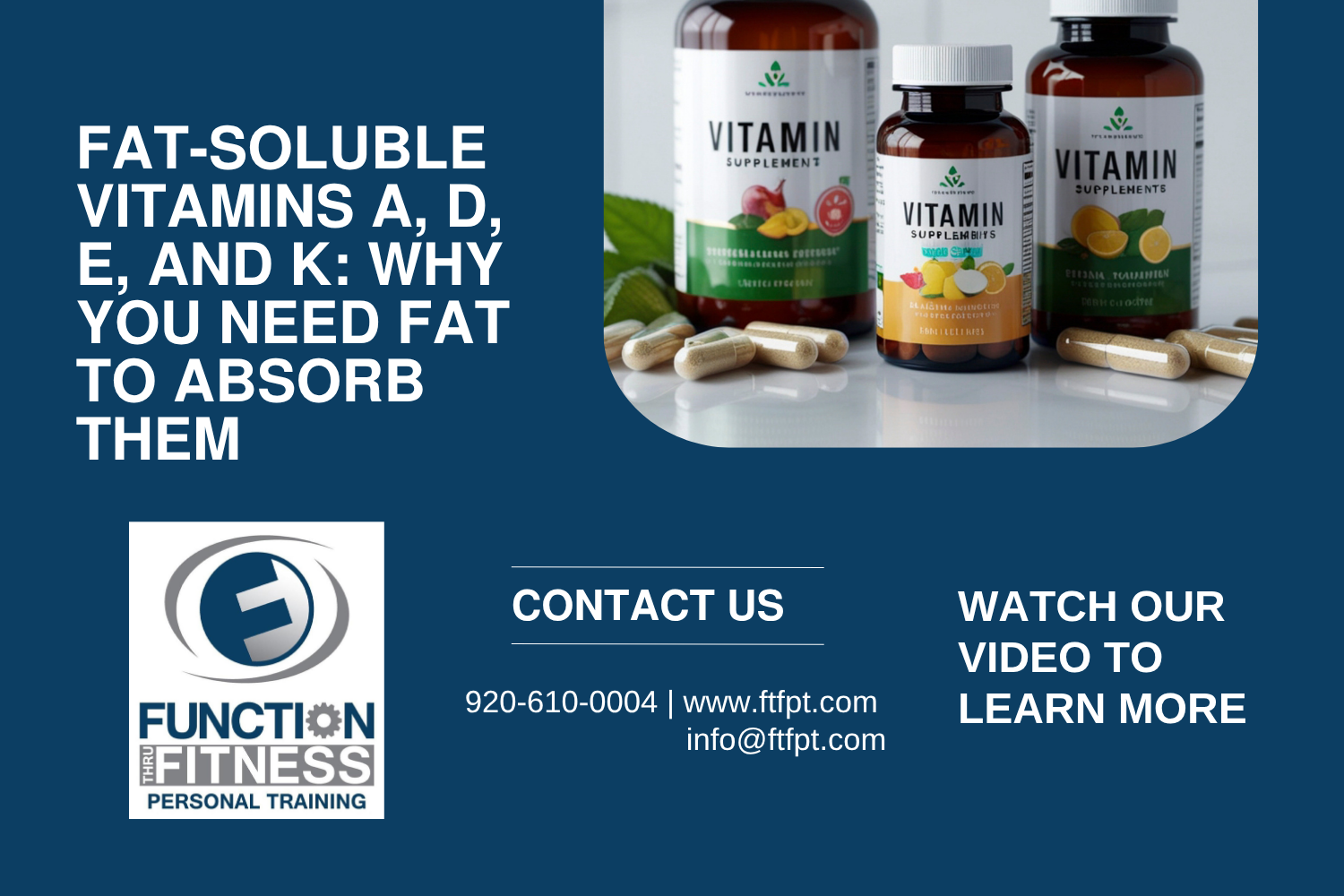
Taking a multivitamin every day feels like a responsible health habit — and it can be. But if your multivitamin contains vitamins A, D, E, or K and you are taking it without fat in your meal, those four vitamins may not be absorbing at all. In this video, John Blaser, NASM-CPT, NASM-CES, NASM-FNS, CBS at Function Thru Fitness in Green Bay, WI breaks down why fat-soluble vitamins behave differently from other nutrients and what that means for how you take your supplements.
What Are Fat-Soluble Vitamins?
Vitamins are divided into two categories based on how they are absorbed and stored in the body: fat-soluble and water-soluble.
Fat-soluble vitamins — A, D, E, and K — require dietary fat to be absorbed through the intestinal wall and transported through the body. They are carried by fat molecules through the lymphatic system and into the bloodstream, then stored in fatty tissue and the liver for later use. Without fat present during digestion, these vitamins cannot complete that absorption process effectively.
Water-soluble vitamins — including vitamin C and the eight B vitamins — dissolve in water and are absorbed directly into the bloodstream. Because they are not stored in significant amounts, they need to be replenished regularly through diet. But they do not depend on fat to absorb, which means timing and meal composition matter less for these nutrients.
Understanding this distinction is one of those practical nutritionist questions that rarely comes up in general health conversations but makes a real difference in day-to-day supplement effectiveness.
Vitamins A, D, E, and K: What Each One Does
Each of the four fat-soluble vitamins plays a distinct role in the body.
Vitamin A supports vision, immune function, and cellular growth. It is found in animal products like liver, eggs, and dairy, as well as in plant foods that contain beta-carotene — a precursor the body converts to vitamin A — such as carrots, sweet potatoes, and leafy greens.
Vitamin D supports calcium absorption, bone health, immune regulation, and muscle function. The body produces it through sun exposure, but many people — particularly in northern climates like Green Bay, WI — are deficient, especially during fall and winter months. Vitamin D deficiency is one of the most common nutrient gaps in the general population.
Vitamin E is a fat-soluble antioxidant that protects cells from oxidative damage and supports immune function. It is found primarily in nuts, seeds, and plant oils.
Vitamin K plays a central role in blood clotting and bone metabolism. Vitamin K2 in particular is involved in directing calcium to bones and away from arterial walls — a function that overlaps with cardiovascular health. It is found in leafy greens, fermented foods, and some animal products.
All four are commonly included in multivitamins. All four require fat to absorb.
Why Taking Your Multivitamin Without Fat Is a Problem
Most people take their multivitamin first thing in the morning — sometimes with water alone, sometimes with coffee, sometimes with a low-fat breakfast. For water-soluble vitamins, this timing is fine. For vitamins A, D, E, and K, it means those nutrients are largely passing through the digestive system without being absorbed.
The fat-soluble absorption process requires bile, which the gallbladder releases in response to fat in a meal. Bile emulsifies the fat, and the fat-soluble vitamins travel with those fat molecules through the intestinal lining and into the lymphatic system. When there is no fat present, bile release is minimal, and the absorption pathway for vitamins A, D, E, and K is essentially closed.
The result is straightforward: if you are consistently taking fat-soluble vitamins without dietary fat, you are spending money on supplements that are not delivering their intended benefit.
How to Fix It: Pairing Fat With Fat-Soluble Vitamins
The correction requires no significant change to a supplement routine — only a change to timing or meal composition.
Take your multivitamin with a meal that includes a source of healthy fat. This does not require a large amount of fat. Even a modest serving of any of the following is sufficient to trigger the absorption process:
Avocado or avocado oil
Olive oil — even a small amount used in cooking or as a dressing
Eggs — the yolk contains fat that supports absorption
Nuts or nut butter — almonds, walnuts, peanut butter
Full-fat dairy — yogurt, cheese, or whole milk
Fatty fish — salmon, sardines, or mackerel
If morning supplement timing is important to you, the simplest adjustment is pairing your multivitamin with breakfast rather than taking it separately. A meal that includes eggs, avocado toast, or even a handful of nuts alongside other foods provides enough fat to support absorption of vitamins A, D, E, and K.
Questions to Ask a Nutritionist About Supplements
Supplement habits are one of the areas where small adjustments produce meaningful results — and where working with a nutrition coach makes the process more precise. Generic supplement advice treats everyone the same. Nutrition coaching at Function Thru Fitness in Green Bay, WI starts with your current habits, your health goals, and your lifestyle, then identifies where the gaps are and how to address them practically.
Common areas that come up in nutrition coaching consultations include supplement timing and pairing, protein and fiber targets, hydration, and how nutrition aligns with a client's training program. These are the questions to ask a nutritionist that most people never get answered clearly — and the details that separate a supplement routine that works from one that costs money without delivering results.
Are there any Green Bay gyms with nutrition coaching services? Function Thru Fitness offers Nutrition Coaching as part of a comprehensive whole-body approach to health, alongside personal training, corrective exercise, and specialty wellness services at 801 Hoffman Rd Suite 103 in Green Bay, WI.
Watch the Full Video
FAQ’s
What are fat-soluble vitamins? Fat-soluble vitamins are vitamins A, D, E, and K. Unlike water-soluble vitamins, they require dietary fat to be absorbed through the intestinal wall and transported through the body. They are stored in fatty tissue and the liver, which means they can accumulate over time but also means they depend on fat being present during digestion to absorb effectively.
Why do vitamins A, D, E, and K need fat to absorb? Fat-soluble vitamins travel through the body by binding to fat molecules. When fat is present in a meal, the gallbladder releases bile to emulsify that fat, and the fat-soluble vitamins are absorbed along with it through the intestinal lining and into the lymphatic system. Without fat in the meal, this absorption pathway is not adequately activated.
What happens if you take fat-soluble vitamins without fat? If vitamins A, D, E, or K are consumed without dietary fat, they are largely not absorbed and pass through the digestive system without being used. This means that consistently taking a multivitamin without fat in the meal may provide little to no benefit for those four specific nutrients, regardless of the dose.
How much fat do you need to absorb fat-soluble vitamins? A small to moderate amount of healthy fat is sufficient — you do not need a high-fat meal. A serving of avocado, a tablespoon of olive oil, a handful of nuts, or a whole egg all provide enough fat to support absorption of fat-soluble vitamins A, D, E, and K.
How does nutrition coaching help with supplement use? A nutrition coach evaluates your current habits, goals, and lifestyle to identify where gaps exist and how to address them practically. At Function Thru Fitness in Green Bay, WI, nutrition coaching covers supplement timing and pairing, macronutrient targets, hydration, and how nutrition integrates with your training — giving you a personalized plan rather than generic advice.
Looking for a better way to stay strong, mobile, and pain-free as you age?
At Function Thru Fitness, we go beyond big-box gyms. As one of the established fitness centers green bay wi, our focus is on restoring how the body moves, reducing pain, and building long-term strength through a proven function fitness approach.
We help people move better at every stage of life through personalized training, corrective exercise, golf fitness, neuromuscular therapy, and athlete recovery.
Download our free guide: Essential Exercises for Lifelong Mobility and Independence www.ftfpt.com/essential-exercises
Visit us at 801 Hoffman Rd. Suite 103, Green Bay, WI Book online at www.ftfpt.com