
Banded Scapula Retraction: Fix the Imbalance Behind Most Shoulder Pain
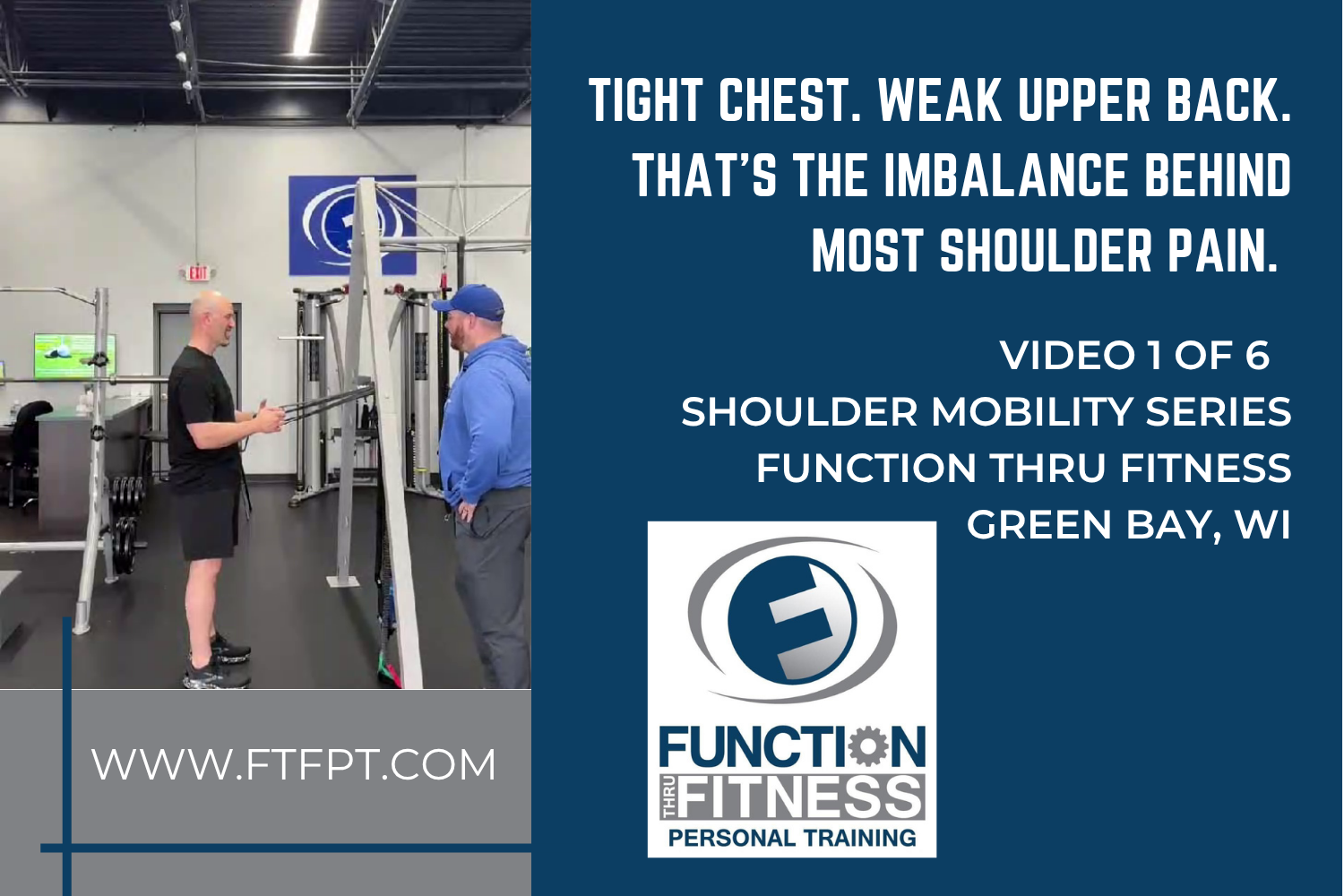
The banded scapula retraction strengthens the mid and lower trapezius — the upper back muscles that hold the shoulder blades in proper position. By directly opposing the tightness of the chest muscles, this exercise corrects the forward shoulder posture that causes most chronic shoulder pain and limited range of motion.
Shoulder pain is one of the most common reasons people come to Function Thru Fitness in Green Bay, WI looking for help. And in most cases, the problem is not what they think it is.
The shoulder itself is often the site of the pain, but rarely the source. What creates the discomfort — the tightness, the limited range, the ache that lingers through the day — is almost always an imbalance between the chest and the upper back. The chest becomes tight. The upper back becomes weak. The shoulders get pulled forward out of their natural position, and the joint pays the price.
Understanding that imbalance is where corrective exercise begins. And the banded scapula retraction is one of the most direct exercises for addressing it.
In this video, Ben walks Glen through the exercise from setup to execution. This is Video 1 in our shoulder mobility series — six videos covering the foundational movements we use to restore healthy shoulder function at Function Thru Fitness.
Why the Chest-Upper Back Imbalance Develops
Most people spend the majority of their day in a position that shortens the chest and stretches the upper back. Sitting at a desk, driving, looking at a phone, working at a computer — all of these activities encourage the shoulders to round forward. Over time, the chest muscles adapt to that shortened position and become tight. The mid and lower trapezius, which are designed to retract and depress the shoulder blades, are constantly lengthened and stop firing effectively.
This is how do I fix poor posture and movement patterns starts to get answered — not with general stretching, but with understanding which specific muscles are overactive, which are underactive, and building programming that directly corrects the imbalance.
When the shoulder blades cannot retract and depress properly, the joint loses its stability. The rotator cuff has to work harder to compensate. Shoulder exercises range of motion becomes limited not because the joint itself is damaged, but because the muscles responsible for positioning it correctly are not doing their job.
How to Perform the Banded Scapula Retraction
Watch the video to see Glen demonstrate the movement with my coaching cues before trying it yourself. Here is the full breakdown:
Set up the band so it sits behind both shoulders at the base of the trapezius — not up near the neck. Slip one arm through each loop and clasp both hands together behind the back at the small of the lower back.
From this starting position, allow the shoulders to drift forward with the tension of the band. This is the starting position — a slight forward position that puts the mid and lower trap on stretch.
From there, drive the shoulder blades together and down. The down component is the piece most people miss. The goal is to retract and depress simultaneously — drawing the shoulder blades toward each other and toward the back pockets at the same time. This is what isolates the mid to low trap and keeps the upper trap from taking over.
No shrugging. No elevation. If the shoulders rise toward the ears, the upper trap is compensating and the exercise loses its targeted benefit. Keep everything moving down and together.
Perform 10 to 15 repetitions with controlled intention on each rep.
The Cue That Makes It Work
The back pocket cue is the most important technical detail in this exercise. When clients think only about squeezing the shoulder blades together, the upper trap frequently gets involved, which elevates the shoulder girdle and shifts the work away from the muscles we are trying to target.
Thinking about driving the shoulder blades down — toward the back pockets — keeps the depression component active throughout the movement. That combination of retraction and depression is what activates the mid to low trap specifically and builds the strength that directly opposes the tight chest muscles pulling the shoulders forward.
This is the level of coaching specificity that makes corrective exercise different from general strength training. The exercise looks simple. The detail in execution is what makes it therapeutic.
Who Benefits From the Banded Scapula Retraction
This exercise is appropriate for a wide range of people. Anyone dealing with chronic shoulder pain, forward shoulder posture, or limited shoulder exercises range of motion will benefit from including this movement in their program. It is also an effective component of rehab exercises for rotator cuff recovery, since restoring proper scapular positioning reduces stress on the rotator cuff tendons during all shoulder movements.
Desk workers, drivers, and anyone who spends long hours in a seated or forward-leaning position will find that regular banded scapula retraction work directly counteracts the postural effects of those habits. What causes neck and back pain is often the same mechanism — tight chest, weak upper back, compensatory patterns that spread through the kinetic chain. Addressing the shoulder imbalance with this exercise is frequently an early step in resolving broader postural complaints.
For golfers, strong and properly positioned shoulder blades are also foundational to a healthy swing. The shoulder girdle needs to be stable and mobile to allow the thoracic spine to rotate efficiently. Shoulder exercises strength in the mid and lower trap supports that demand directly.
Can personal training help with chronic pain? The banded scapula retraction is a clear example of why the answer is yes — when programming is built around accurate assessment and targeted corrective exercise, not just general fitness.
What to Expect From This Series
This is the first of six videos in our shoulder mobility series at Function Thru Fitness. Each video addresses a specific component of shoulder function — from scapular control to thoracic mobility to rotational stability — building progressively toward full shoulder health.
If you have been dealing with shoulder discomfort, stiffness, or limited range of motion and have not found lasting relief, this series was built for you. Working through these movements with the coaching cues provided will give you a foundation for understanding what your shoulders need.
For a program built specifically around your body's movement patterns, a Functional Assessment at Function Thru Fitness allows us to identify exactly where the restrictions are and build corrective exercise programming that addresses them directly.
Watch the Full Video
FAQ’s
Q: What causes shoulder pain that keeps coming back? A: Recurring shoulder pain is most often the result of a muscular imbalance between the chest and upper back. When the chest becomes tight and the mid to low trapezius becomes weak, the shoulders are pulled forward out of proper alignment. This creates ongoing stress on the shoulder joint and rotator cuff that does not resolve without correcting the underlying imbalance through targeted corrective exercise.
Q: How do I fix poor posture and movement patterns causing shoulder problems? A: Fixing the posture and movement patterns behind shoulder problems starts with identifying which muscles are overactive and which are underactive. In most cases, the chest is tight and the mid to low trap is weak. Exercises like the banded scapula retraction directly address that imbalance by strengthening the upper back muscles that hold the shoulder blades in proper position. A Functional Assessment can identify your specific pattern and guide the most effective approach.
Q: What are good shoulder exercises range of motion for people with pain? A: Shoulder exercises range of motion for people dealing with pain should prioritize restoring proper scapular position before loading the joint. The banded scapula retraction is one of the most effective starting points because it strengthens the muscles responsible for shoulder blade positioning without placing any stress on the joint itself. From there, range of motion exercises can be introduced progressively as the shoulder stabilizes.
Q: Can personal training help with chronic pain in the shoulders? A: Yes. Can personal training help with chronic pain depends entirely on how the programming is built. When a corrective exercise specialist assesses the movement patterns driving the pain and builds a program that directly addresses the imbalances causing it, personal training is one of the most effective long-term approaches to chronic shoulder pain. Generic gym programming rarely achieves the same result because it does not account for the individual mechanics behind the problem.
Q: Are banded scapula retraction exercises helpful for rotator cuff issues? A: The banded scapula retraction is frequently included in rehab exercises for rotator cuff programs because scapular positioning directly affects how much stress the rotator cuff tendons experience during shoulder movement. When the shoulder blades are positioned properly — retracted and depressed — the rotator cuff can function with significantly less strain. Strengthening the mid and low trap through this exercise is often a foundational step in reducing rotator cuff discomfort.
Looking for a better way to stay strong, mobile, and pain-free as you age?
At Function Thru Fitness, we go beyond big-box gyms. As one of the established fitness centers green bay wi, our focus is on restoring how the body moves, reducing pain, and building long-term strength through a proven function fitness approach.
We help people move better at every stage of life through personalized training, corrective exercise, golf fitness, neuromuscular therapy, and athlete recovery.
Download our free guide: Essential Exercises for Lifelong Mobility and Independence www.ftfpt.com/essential-exercises
Visit us at 801 Hoffman Rd. Suite 103, Green Bay, WI Book online at www.ftfpt.com