
Foam Roller Serratus Slides: The Final Piece for Overhead Shoulder Pain Relief
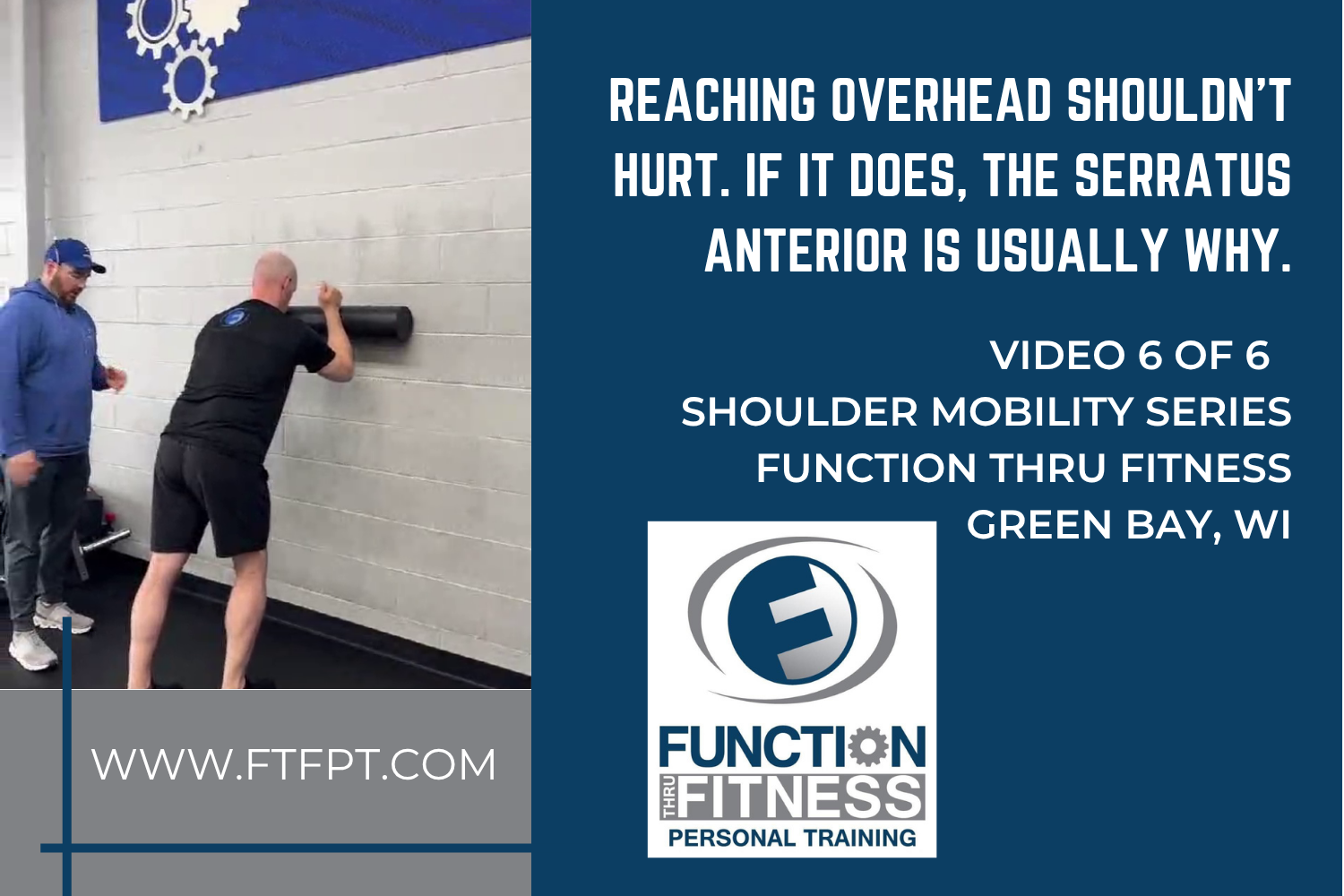
Foam roller serratus slides train the serratus anterior — the muscle responsible for holding the shoulder blade flat against the rib cage during overhead movement. By pressing the upper back outward while sliding the roller up the wall with core braced and back flat, this exercise directly addresses the weakness behind most overhead shoulder pain and builds the scapular control that pain-free reaching requires.
Shoulder pain when reaching overhead is the complaint that brings a lot of people to Function Thru Fitness in Green Bay, WI. They reach for something on a shelf, put a bag in an overhead bin, or raise their arm during exercise — and the shoulder catches, pinches, or aches. It has often been going on for months.
In most cases the source is the same: the serratus anterior is not doing its job.
The serratus anterior is a muscle that runs along the side of the rib cage and attaches to the medial border of the shoulder blade. Its job is to protract the shoulder blade and press it flat against the rib cage during overhead movement. When it works correctly, the shoulder blade glides smoothly upward as the arm rises, keeping the subacromial space open and the rotator cuff clear. When it is weak, the shoulder blade tips away from the rib cage — a pattern called scapular winging — the subacromial space narrows, the rotator cuff is compressed, and overhead movement becomes painful.
This is why the serratus anterior is the muscle this final video in our shoulder mobility series focuses on. The first five videos built the foundation — scapular retraction strength, full-range scapular mobility, circumduction, external rotation, and posture correction. Video 6 applies all of that at the functional overhead range where most shoulder pain actually lives.
In this video, I walk Glen through foam roller serratus slides — the exercise that closes the series at the most meaningful point.
Why the Serratus Anterior Is So Consistently Undertrained
The serratus anterior does not appear in most standard shoulder programs. Rows, face pulls, and band exercises address the trapezius and posterior rotator cuff. Pressing exercises load the anterior deltoid and chest. The serratus — despite being one of the most important muscles for overhead shoulder health — is rarely trained directly.
The result is a common pattern: clients with reasonable overall shoulder strength who still experience overhead pain, limited overhead range, or visible shoulder blade winging during arm elevation. The strength is there in the muscles that get trained. The deficit is in the one that does not.
Foam roller serratus slides close that gap by isolating the serratus in a position that directly mirrors overhead function — loaded, wall-supported, with the shoulder blade required to stay against the rib cage throughout the movement.
How to Perform Foam Roller Serratus Slides
Watch the video to see Glen move through the full exercise before attempting it yourself.
Stand facing a wall with feet staggered for stability. The back should be flat — not arched — with the hips stacked directly underneath the torso. Place both wrists on the foam roller against the wall at approximately chest height.
From that starting position, slide the foam roller up the wall. The key coaching cue throughout is to press the upper back outward — away from the wall, toward where a spotter's hands would be behind the shoulder blades. That pressing-out sensation is the serratus anterior firing to hold the shoulder blade against the rib cage as the arm elevates.
Maintain tight abs throughout the movement. The bracing core exercise component is not secondary — it is essential. Without core engagement, the lower back arches as the roller rises, the hips shift forward, and the upper back rounds rather than pressing out. Core bracing maintains the flat back position that allows the serratus to do its job under load.
Slide as high as the shoulder allows with the upper back pressed out, then return down in a controlled manner. The farther the feet are walked away from the wall, the more horizontal the body angle becomes and the greater the load on both the serratus and the core. Adjust the foot position to match the current level of shoulder exercises strength and core stability.
The Progression Built Into the Exercise
Like the wall guide in the half kneeling windmill from Video 4, this exercise has a built-in progression. As the serratus anterior and core strengthen, the feet can be walked progressively farther from the wall — increasing the load without changing the exercise or requiring additional equipment. That progressive structure makes it practical for home use as well as in a training environment.
Who Benefits Most From This Exercise
Anyone dealing with overhead shoulder pain will benefit directly from this exercise — and that includes a wide range of people.
For desk workers and older adults, overhead activities like reaching for shelves, putting on a coat, or lifting items above shoulder height are everyday functional movements. When these cause pain, quality of life is affected. For people focused on mobility for seniors, maintaining pain-free overhead range is one of the most practical mobility goals, and serratus anterior strength is foundational to it.
For golfers, the serratus anterior contributes to shoulder blade stability during the backswing and follow-through. Weakness here is a common contributing factor to shoulder discomfort in golfers, particularly through the overhead and behind-the-body ranges of the swing.
For anyone working through rehab exercises for rotator cuff issues, serratus strength is one of the variables most frequently implicated in ongoing rotator cuff stress. Restoring it is often the missing step that allows the rotator cuff to function without the compensatory strain that perpetuates pain.
Closing the Series
This is the sixth and final video in our shoulder mobility series at Function Thru Fitness in Green Bay, WI. The series was built to address the full picture of shoulder health — from the muscles that hold the shoulder blade in place, to the range of motion those muscles need to control, to the functional overhead strength that daily life and athletic performance require.
If shoulder pain has been a persistent issue and you have not found lasting relief, working through these six exercises as a progressive sequence addresses the mechanism behind most common shoulder complaints. For a program built specifically around your shoulder mechanics and movement patterns, a Functional Assessment identifies exactly where the deficits are and guides the most effective corrective exercise approach for your body.
FAQ
Q: Why does my shoulder hurt when I reach overhead? A: Overhead shoulder pain is most often caused by weakness in the serratus anterior — the muscle responsible for holding the shoulder blade flat against the rib cage during arm elevation. When the serratus is weak, the shoulder blade tips away from the rib cage as the arm rises, narrowing the space where the rotator cuff passes and creating the pinching or aching sensation that overhead movement produces. Strengthening the serratus through targeted shoulder exercises strength work like foam roller serratus slides directly addresses this cause.
Q: What is the serratus anterior and why does it matter for shoulder health? A: The serratus anterior is a muscle running along the lateral rib cage that attaches to the medial border of the shoulder blade. Its primary role is to protract the shoulder blade and press it flat against the rib cage — particularly during overhead movement. When it is weak, the shoulder blade loses contact with the rib cage, the subacromial space narrows, and overhead shoulder pain develops. It is one of the most consistently undertrained muscles in standard shoulder programs despite being central to overhead shoulder health.
Q: How does core bracing relate to shoulder pain relief? A: Core bracing during shoulder exercises maintains the spinal position required for the shoulder blade to move correctly. When the core releases during overhead movement, the lower back arches and the upper back rounds — which shifts the shoulder mechanics and prevents the serratus from doing its job. Keeping the abs engaged throughout foam roller serratus slides is what allows the upper back to press outward and the shoulder blade to stay against the rib cage under load.
Q: Are serratus anterior exercises appropriate for rotator cuff issues? A: Yes. Serratus anterior weakness is one of the most common contributing factors to ongoing rotator cuff stress. The rotator cuff keeps the humerus centered in the shoulder socket, and it cannot do that effectively when the shoulder blade is not held in proper position by the serratus. Strengthening the serratus through exercises like foam roller serratus slides is frequently a foundational component of rehab exercises for rotator cuff programs.
Q: How do all six exercises in this shoulder mobility series work together? A: The series builds progressively from foundational scapular strength to functional overhead loading. Video 1 establishes mid and low trap strength through banded scapula retraction. Video 2 adds full retraction and protraction range. Video 3 trains all four directions of scapular movement together. Video 4 reclaims shoulder circumduction range. Video 5 builds external rotation strength and posture integration. Video 6 applies the full foundation to overhead movement with serratus activation and core bracing. Each exercise prepares the shoulder for the demands of the next.
Looking for a better way to stay strong, mobile, and pain-free as you age?
At Function Thru Fitness, we go beyond big-box gyms. As one of the established fitness centers green bay wi, our focus is on restoring how the body moves, reducing pain, and building long-term strength through a proven function fitness approach.
We help people move better at every stage of life through personalized training, corrective exercise, golf fitness, neuromuscular therapy, and athlete recovery.
Download our free guide: Essential Exercises for Lifelong Mobility and Independence www.ftfpt.com/essential-exercises
Visit us at 801 Hoffman Rd. Suite 103, Green Bay, WI Book online at www.ftfpt.com