
Kneeling Hip Flexor Stretch: Why Most People Do It Wrong and How to Fix It
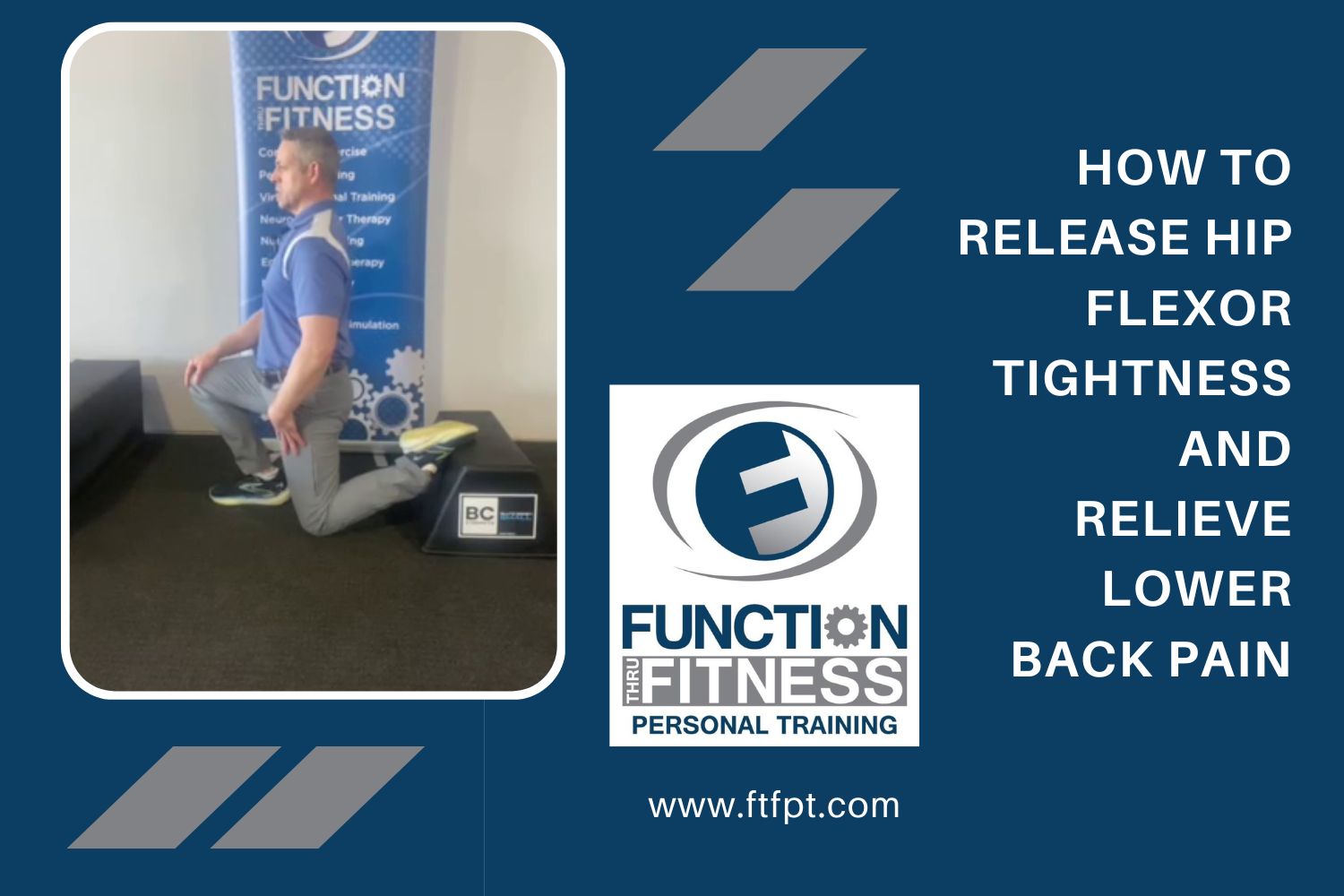
The kneeling hip flexor stretch is one of the most widely recommended corrective exercise techniques for lower back pain and anterior hip tightness. It appears in warm-up routines, physical therapy protocols, and corrective exercise programs around the world. It is also one of the most consistently performed in a position that prevents the target muscle from being fully stretched — because the critical activation cue is almost never taught.
In this video, Chad Gossen, CPNMT, LMT, NASM-CPT, CES at Function Thru Fitness in Green Bay, WI demonstrates the kneeling hip flexor stretch using the bottom step at home, with the two technique details that make the difference between a stretch that actually releases the hip flexor and one that just goes through the motions. Watch the video first to see both cues before reading the breakdown below.
Why Hip Flexor Tightness Drives Lower Back Pain
The hip flexors are a group of muscles responsible for bringing the thigh toward the torso. The primary contributors are the iliopsoas — which includes the iliacus and the psoas major — and the rectus femoris, one of the four quadricep muscles that also crosses the hip joint. Because of their attachment points on the anterior pelvis and lumbar vertebrae, the hip flexors have a direct mechanical relationship with the lower back.
When the hip flexors are chronically shortened — as they frequently are in anyone who sits for extended periods, drives regularly, or spends long hours in a forward-flexed position — they pull the anterior pelvis downward and forward. This creates an anterior pelvic tilt that increases the lumbar curve and places sustained compression on the posterior structures of the lower back. The lower back tightness that follows is not a back problem. It is a hip flexor problem manifesting in the back.
This is why the best stretch exercises for lower back pain that produce lasting results consistently address the hip flexors — and why a hip flexor stretch done without the correct activation cue often fails to create meaningful change despite being performed regularly.
The Glute Squeeze — The Cue That Changes Everything
The most important instruction in Chad's demonstration is the glute squeeze, and understanding why it matters makes the difference between a stretch that works and one that does not.
In a standard kneeling lunge position — even one that looks correct from the outside — the pelvis has a strong tendency to tilt anteriorly. This is the natural resting position of the hip flexors when the hip is in flexion with the knee on the floor. The problem is that an anteriorly tilted pelvis is exactly the position that shortens the hip flexors. If the hip flexors are already in their shortened state, they cannot be stretched regardless of how long the position is held.
Contracting the gluteus maximus on the side being stretched actively posteriorly tilts the pelvis — pulling the front of the pelvis upward and the back of the pelvis downward. This pelvic movement directly opposes the shortened position of the hip flexors and forces them into a lengthened state. The moment the glute squeeze is applied, the hip flexor comes under real tension for the first time. The stretch changes character immediately — what felt like a mild pull becomes a deep, sustained stretch through the front of the hip.
This one cue is what makes the kneeling hip flexor stretch one of the best stretch exercises for lower back pain rather than just another warm-up movement that fills time without producing change.
The Arm Raise — Extending the Stretch Through the Trunk
The second cue Chad demonstrates is the arm raise. On the same side as the hip being stretched, the arm reaches upward toward the sky and falls in line with the ear.
This arm position serves a specific purpose. The iliopsoas does not end at the pelvis — the psoas major originates from the lumbar vertebrae and the thoracolumbar fascia connects the trunk to the hip through the posterior and lateral chain. Raising the arm on the ipsilateral side creates a lateral lengthening through the trunk that draws the upper fibers of the hip flexor complex and the thoracolumbar fascia into the stretch simultaneously.
The result is a full-length release from the front of the hip all the way up through the side body — a significantly more comprehensive stretch than the pelvic-level release alone.
How to Perform the Kneeling Hip Flexor Stretch
Chad's technique uses the bottom step at home, which elevates the back foot slightly and increases the anterior reach of the hip on the side being stretched. Any stable low step or platform works.
Set up the position. Place the back foot on the bottom step and lower the back knee toward the floor in a kneeling lunge. The front leg is positioned forward with the knee over the ankle. This is the starting position.
Squeeze the glute. Before moving into the stretch, contract the glute of the hip being stretched — the side with the back knee down. This posterior pelvic tilt is the prerequisite for the stretch to be effective. Hold that contraction throughout.
Raise the arm and align with the ear. With the glute engaged and the pelvis in the corrected position, raise the arm on the same side as the hip being stretched up toward the sky and allow it to fall in line with the ear. Feel the stretch extend from the front of the hip upward through the side body.
Hold, then release. Maintain the position with the glute contracted and the arm raised, then release and return to the starting position.
Who Benefits From This Stretch
The kneeling hip flexor stretch with proper activation is relevant across nearly every population FTF serves.
For anyone dealing with chronic lower back pain, this technique addresses one of the most common and most consistently missed root causes. It is among the best stretch exercises for lower back pain precisely because it targets the anterior hip restriction that drives lumbar tension — not just the back itself.
For golfers, hip flexor flexibility is directly linked to golf hip rotation and the ability to achieve a full backswing and follow-through. Tight hip flexors limit the pelvis's ability to rotate freely, force the lower back to compensate, and reduce the power and range of motion available through the swing. Including this stretch in a golf flexibility training routine addresses the anterior hip restriction that is frequently at the root of golf-related lower back pain and swing limitation.
For older adults, hip flexor tightness and the anterior pelvic tilt it creates are among the most common postural patterns affecting gait, balance, and lower back comfort. Including this stretch in a regular senior stretching exercises program supports hip extension range of motion and lumbar decompression that daily movement quality depends on. Done consistently, it contributes to the lifelong mobility that allows people to move freely and confidently across the decades.
For desk workers and anyone whose lifestyle involves prolonged sitting, the hip flexors are in a shortened position for hours each day. Without consistent stretching that actually reaches full muscle length — achieved only with the glute squeeze cue — the cumulative shortening builds into the pattern that drives chronic lower back tension.
Frequently Asked Questions
Why does squeezing the glute improve the hip flexor stretch? The glute squeeze produces posterior pelvic tilt, which directly opposes the anteriorly tilted pelvis that most people maintain in a kneeling lunge position. Without the correction, the pelvis tilts forward and the hip flexors remain in a shortened state — making the stretch ineffective regardless of how long it is held. Contracting the glute forces the hip flexor into full length, which is the prerequisite for the stretch to produce meaningful change.
Can hip flexor tightness cause lower back pain? Yes. The hip flexors attach to the anterior pelvis and lumbar vertebrae. Chronic tightness pulls the pelvis into anterior tilt and increases lumbar lordosis, placing sustained compressive load on the posterior lower back. The kneeling hip flexor stretch done correctly is one of the best stretch exercises for lower back pain that addresses this root cause.
Is the kneeling hip flexor stretch good for golfers? Hip flexor flexibility directly affects the pelvis's ability to rotate freely during the golf swing. Tight hip flexors limit golf hip rotation, reduce backswing and follow-through range, and force the lower back to compensate — a common source of golf-related back pain. Including this stretch in a golf flexibility training routine addresses the anterior hip restriction that undermines both swing mechanics and lower back health.
Why is the arm raised during the hip flexor stretch? Raising the arm on the same side as the hip being stretched creates a lateral lengthening through the trunk that draws the upper fibers of the hip flexor complex and the thoracolumbar fascia into the stretch. This extends the technique beyond the anterior hip and produces a more complete release from the front of the hip through the entire side body.
How often should you do the kneeling hip flexor stretch? For clients with chronic hip flexor tightness or lower back pain, daily stretching produces the most consistent results. The stretch can be included in a morning mobility routine, as part of a pre-activity warm-up, or as a standalone daily practice. As part of a corrective exercise program, frequency and volume are typically determined based on the individual's assessment findings.
Start Moving Better
If hip flexor tightness, lower back pain, or restricted hip mobility has been affecting your movement and your daily life, Chad Gossen and the team at Function Thru Fitness in Green Bay, WI are here to help. Every program begins with a thorough assessment of how your body is actually moving — so the work we do together targets the real source of the problem.
Book with Chad at www.ftfpt.com/chad
Looking for a better way to stay strong, mobile, and pain-free as you age?
At Function Thru Fitness, we go beyond big-box gyms. As one of the established fitness centers green bay wi, our focus is on restoring how the body moves, reducing pain, and building long-term strength through a proven function fitness approach.
We help people move better at every stage of life through personalized training, corrective exercise, golf fitness, neuromuscular therapy, and athlete recovery.
Download our free guide: Essential Exercises for Lifelong Mobility and Independence www.ftfpt.com/essential-exercises
Visit us at 801 Hoffman Rd. Suite 103, Green Bay, WI Book online at www.ftfpt.com