
How Neuromuscular Therapy Identifies the Root Cause — Not Just the Symptom
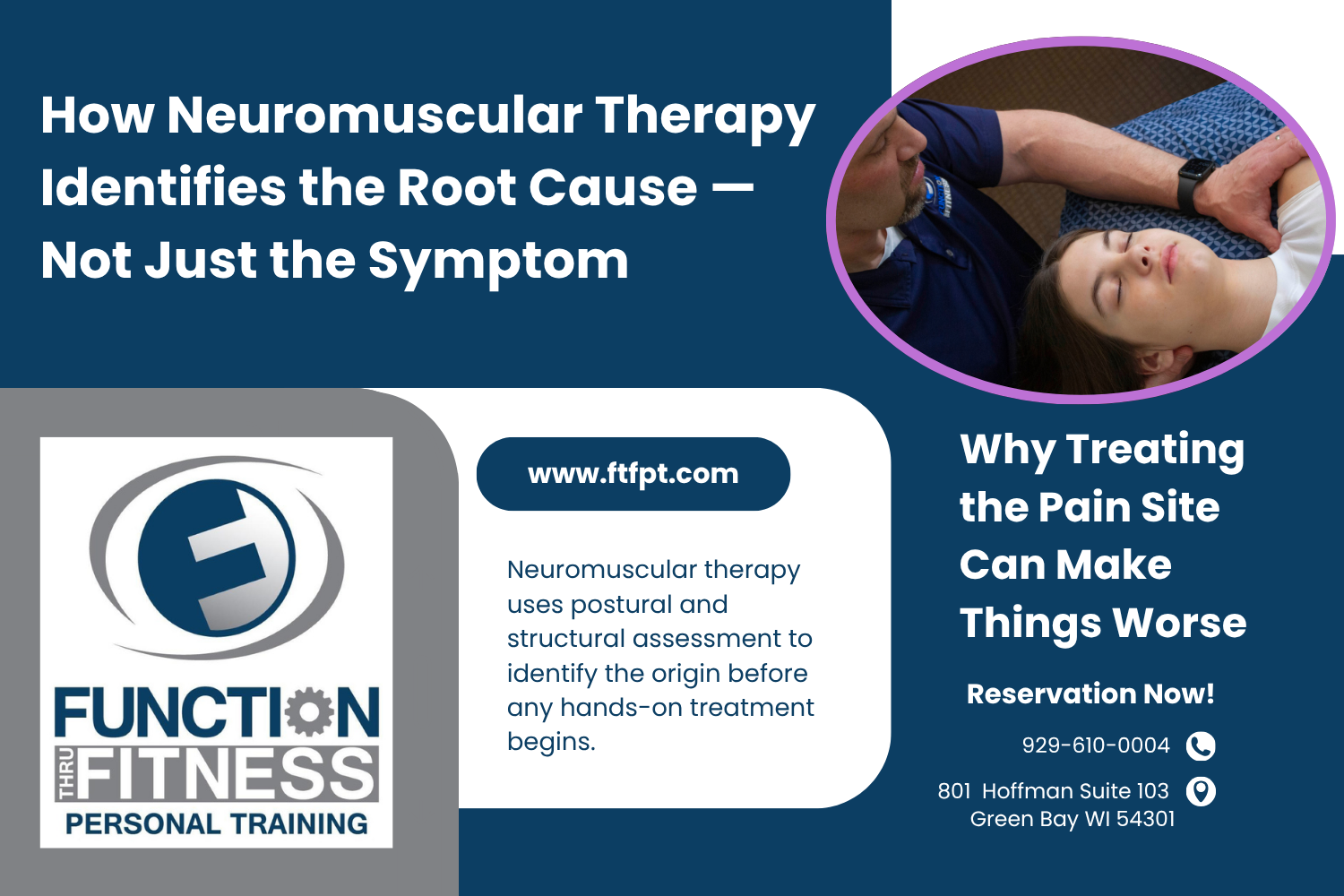
In neuromuscular therapy massage, the first principle of assessment is this: the root cause of pain is almost never located where the symptom is felt. This distinction — between the site of pain and the source of pain — is what separates NMT from general treatment and explains why so many people find relief through neuromuscular therapy after other approaches have failed. Understanding how NMT identifies root cause is also the answer to one of the most common questions people bring to a first session: why am I still in pain even after therapy?
Why Treating the Pain Site Can Make Things Worse
Most people's instinct when they feel pain is to address it directly. Foam roll the tight spot. Press a tennis ball into the knot. Stretch the area that aches. These approaches feel good in the moment — and that temporary relief is exactly what makes them misleading.
When pain is a symptom of a structural imbalance elsewhere in the body, the tight tissue at the pain site is under tension because of what is happening at the source. Treating that tissue directly reduces tension momentarily, but it also stimulates the tissue's capacity to contract. Over time, direct treatment of a symptomatic area without addressing the source can deepen the very pattern driving the pain.
Why does my pain keep coming back? For a significant number of people, this is the answer. The location being treated is not the location of the problem.
A Real Case: Rib Pain That Traced Back to the Pelvis
In this video, I share a case that illustrates this principle directly.
A client came in with severe rib pain. She had been managing it with self-treatment and had scheduled a cortisone shot — the pain was that significant. Before proceeding with any hands-on treatment, I completed a postural assessment.
The assessment revealed a pelvis that was considerably off-level. One leg was approximately three quarters of an inch longer than the other — a meaningful structural discrepancy that was visibly affecting how the entire spine and rib cage were positioned.
The rib pain was located on the lengthened side. In NMT assessment, this is a critical distinction. The lengthened side is the side under stretch — the side where tissue is being pulled long. The contracted side is the shorter side, where tissue is shortened and compressing.
Tight tissue has a greater capacity to contract. If she had continued applying direct pressure to the tight area along her ribs — or if treatment had been administered to the symptom location without first identifying the structural imbalance — the relief would have been temporary and the underlying pattern would have been reinforced.
What Changed When the Source Was Addressed
Once the assessment identified the pelvic imbalance as the driver, treatment focused on bringing the pelvis to a neutral position rather than addressing the ribs directly.
The result: the knots along her spine and rib cage resolved on their own. Without any direct treatment to those areas. She cancelled the cortisone shot.
This outcome is not unusual in neuromuscular therapy near me contexts — it reflects what happens consistently when the source of a pattern is corrected rather than its symptoms managed. The body reorganizes around the correction, and tissue that was under abnormal tension releases because the structural reason for that tension has been removed.
What is neuromuscular therapy used for? This case is one of the clearest answers. NMT is used when the origin of pain needs to be identified — when surface-level treatment has failed because it has never reached the source.
How NMT Assessment Identifies Root Cause
The process of identifying root cause in NMT begins with postural assessment. How is the body positioned? Are the shoulders level? Is the pelvis neutral? Is there a visible leg length discrepancy? Is the spine carrying a lateral curve that compensates for an imbalance below?
These observations tell a structural story before any tissue is touched. They indicate not just where the body is tight or restricted, but why — and which areas are under abnormal load as a result of the structural pattern.
From there, range of motion assessment, specific tissue palpation, and client feedback about where sensation travels under pressure build a more complete picture. Referral patterns — where pressure in one location produces sensation in another — are clinical indicators of which tissues are involved in the symptom pattern and which are bystanders.
What is neuromuscular therapy massage? It is this process: systematic assessment first, followed by treatment directed at what the assessment finds — not at what hurts.
Why am I still in pain even after therapy? Because most therapy has treated the hurting location. NMT treats the source location. Those are rarely the same place.
The Problem with Self-Treatment at the Symptom Site
The client in this video had been using self-treatment tools — foam rollers and pressure devices — on her ribs. This is an extremely common pattern. People feel tension, they apply pressure, they feel temporary relief, and they repeat the process.
When the area being treated is a symptomatic tissue — under tension because of a structural imbalance elsewhere — this cycle reinforces the problem. Each session of direct treatment stimulates the tissue's contractile capacity. The relief window may gradually shorten. The tension may gradually increase. And the structural driver continues untouched.
This is not a reason to avoid self-care entirely. It is a reason to have an assessment before applying sustained self-treatment to any area of recurring or unresolved pain. The myofascial release and trigger point therapy approach in NMT is specific precisely because assessment identifies which tissue needs work and which needs to be left alone.
For those in the Green Bay area searching for massage green bay with a clinical assessment focus, or for neuromuscular therapy near me that addresses structural root cause rather than symptom management, Function Thru Fitness provides that level of care.
FAQ — How NMT Finds Root Cause
Q: Why does my pain keep coming back after foam rolling or massage? A: When pain is a symptom of a structural imbalance, treating the symptom location provides temporary relief but reinforces the underlying pattern. Tight tissue has a greater capacity to contract — direct treatment without addressing the source can deepen the problem over time.
Q: Why am I still in pain even after therapy? A: If therapy has consistently treated where the pain appears rather than where it originates, the source has never been addressed. Neuromuscular therapy uses postural and structural assessment to identify the origin before any hands-on treatment begins.
Q: What is neuromuscular therapy used for? A: Neuromuscular therapy is used to identify and treat the structural source of pain — not its symptom location. It is most effective for recurring pain, pain that has not responded to general treatment, and cases where the true origin has never been correctly identified.
Q: What is neuromuscular therapy massage and how does assessment work? A: Neuromuscular therapy massage begins with postural assessment, range of motion evaluation, and specific tissue testing to identify where a symptom is originating. Treatment follows that finding — not the location of discomfort. The session includes continuous client communication and home care at the end.
Q: Can a pelvic imbalance cause pain in the ribs or spine? A: Yes. A pelvis that is off-level creates a structural chain reaction that affects how the spine, rib cage, and surrounding tissue are positioned and loaded. Tissue on the lengthened side is under stretch, which creates tension and knots that can appear far from the actual source of the imbalance.
Book a Session
If pain has been returning despite treatment, or if you have never had an assessment that looked beyond the symptom site, a neuromuscular therapy session is the place to start.
Chad, Heather, Glen, and Stacey all offer neuromuscular therapy at Function Thru Fitness. Book with any of them at the links below.
Book Now:
Chad - chad@ftfpt.com / 920-915-7831 / www.ftfpt.com/chad
Heather- heather@ftfpt.com / 920-676-9387 / www.ftfpt.com/heather
Glen – glen@ftfpt.com / 920-562-4357 / www.ftfpt.com/glen
Stacey- stacey@ftfpt.com / 602-575-6126 / www.ftfpt.com/stacey
Looking for a better way to stay strong, mobile, and pain-free as you age?
At Function Thru Fitness, we go beyond big-box gyms. As one of the established fitness centers green bay wi, our focus is on restoring how the body moves, reducing pain, and building long-term strength through a proven function fitness approach.
We help people move better at every stage of life through personalized training, corrective exercise, golf fitness, neuromuscular therapy, and athlete recovery.
Download our free guide: Essential Exercises for Lifelong Mobility and Independence www.ftfpt.com/essential-exercises
Visit us at 801 Hoffman Rd. Suite 103, Green Bay, WI Book online at www.ftfpt.com