
Half Kneeling Windmill: Reclaiming the Shoulder Mobility That Years of Sitting Takes Away
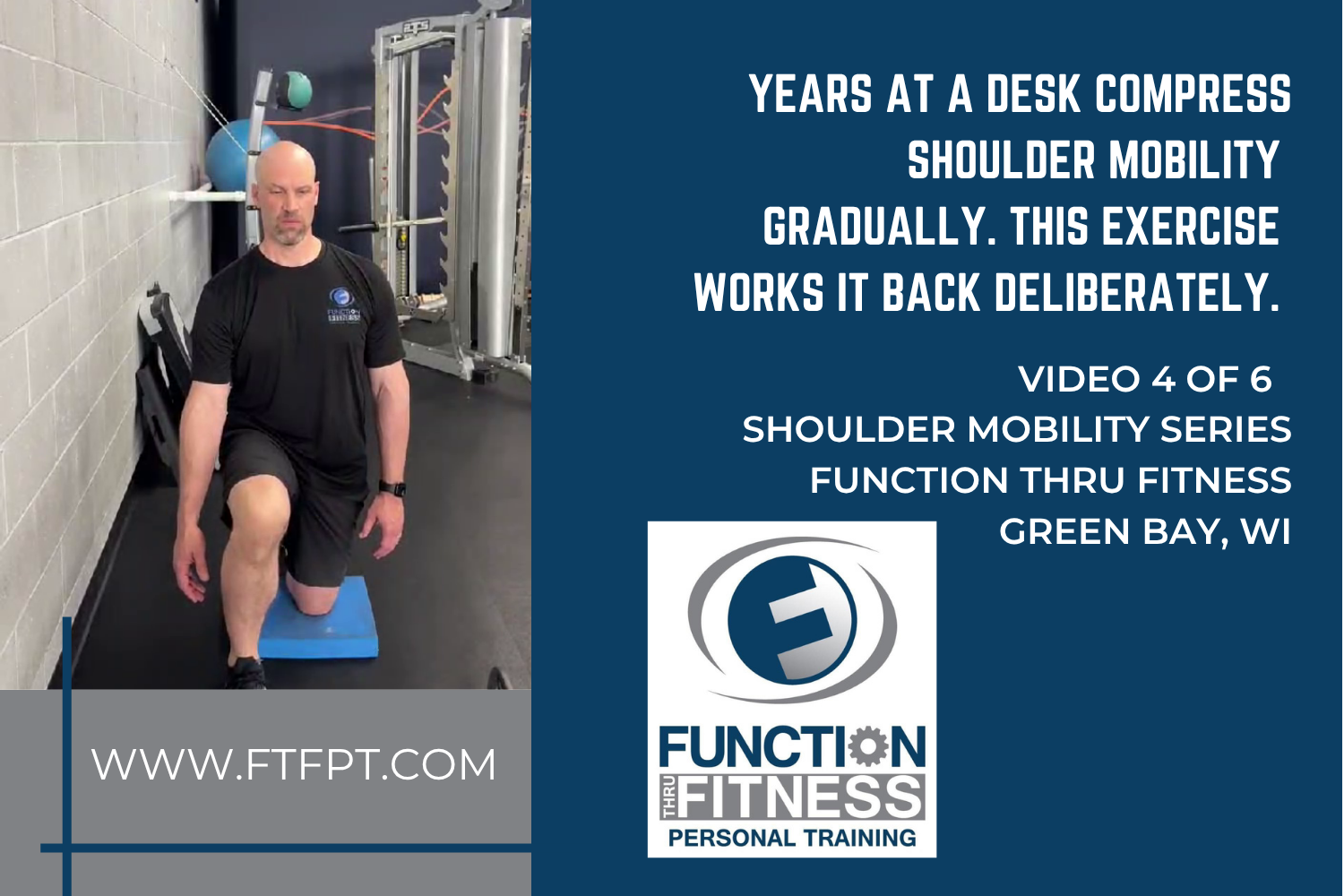
The half kneeling windmill uses a wall as a guide to take the shoulder through a full circular arc with controlled hand rotation at end range. Drawn from Functional Range Conditioning methodology, it reclaims the shoulder range of motion lost to prolonged sitting by actively challenging and expanding the joint's available movement — with the wall distance serving as a built-in progress measure.
Shoulder mobility does not disappear overnight. It goes gradually — hours at a desk each day, arms in front of the body, thoracic spine flexed, shoulder blades rounded forward. Over months and years, the shoulder's available range of motion in rotation and full circumduction compresses. By the time most people notice something is restricted, the limitation has been building for a long time.
The good news is that what sitting takes away can be worked back. But getting it back requires more than passive stretching. It requires taking the shoulder to its current end range and working there intentionally — challenging the range that has been lost and progressively expanding it.
That is the principle behind Functional Range Conditioning, the methodology I am drawing from in this video. I want to give FRC full credit for this exercise — it is one of the most effective shoulder exercises range of motion drills I have incorporated into my programming at Function Thru Fitness in Green Bay, WI, and it fits naturally as Video 4 in our six-part shoulder mobility series.
What Is Functional Range Conditioning and Why Does It Matter Here
Functional Range Conditioning — FRC — is a system of mobility training built around the concept that the body only owns the range of motion it has been trained to actively control. Passive flexibility, where a muscle is stretched without active engagement, does not translate to functional range. The shoulder might feel looser after a passive stretch, but under load or during complex movement, the body reverts to the range it can actually control.
FRC addresses this by taking joints to their end range and training active muscular control there. Over time, the nervous system learns to trust and use that range, and it becomes genuinely available rather than just accessible under passive conditions.
The half kneeling windmill applies this principle to the shoulder. It takes the joint through a full circular arc — circumduction — with deliberate hand rotation at the points where the shoulder transitions from one direction of movement to another. Every part of that arc challenges the shoulder at or near its current end range, and consistent training with this exercise progressively expands what that range is.
How to Perform the Half Kneeling Windmill
Watch the video to see Glen move through the full movement before attempting it yourself.
Start in a half kneeling position facing a wall, positioned far enough away that the arm does not touch the wall during the arc. The wall is a guide only — it should never be used as a support.
Begin with the hand in a neutral position — a karate chop orientation — down by the hip. From there, sweep the arm forward and up in a large circular arc, keeping the thumb facing backward as far as the movement allows. The key is to maintain that thumb-back orientation as long as possible rather than letting the hand rotate early.
At the point where the shoulder can no longer continue the arc without losing control — typically somewhere in the overhead or behind-the-body range — rotate the hand all the way over and finish the forward arc with the pinky up.
For the return: keep the pinky down toward the floor the entire arc back, sweeping through the full circle in the opposite direction. At the endpoint, rotate the hand back to the neutral starting position.
Throughout both directions, the goal is full range, controlled movement, and staying off the wall. No contact with the wall means the shoulder is doing the work on its own. The wall is there to show you where you are — not to help you get there.
The Progress Built Into the Exercise
One of the features that makes this exercise particularly valuable in a long-term corrective exercise program is its built-in progress measure. The starting position — how close to the wall Glen can stand before the arc begins — is determined by his current shoulder mobility. As that mobility expands through consistent training, he can move progressively closer to the wall and still complete the full arc without contact.
That means the exercise gets harder as the client improves, without requiring any equipment changes or programming adjustments. The wall does the work of scaling automatically.
For anyone asking how do I fix poor posture and movement patterns built up over years of desk work, that progressive structure is exactly what makes this approach more effective than static stretching. Shoulder exercises range of motion improve when end range is consistently challenged and expanded over time — not when the same comfortable range is repeated indefinitely.
Who Benefits Most From This Exercise
This exercise is relevant for a wide range of people but is particularly valuable for desk workers and anyone whose shoulder mobility has been gradually compressed by prolonged sitting. The half kneeling windmill directly targets the circumduction range and rotational control that those movement patterns restrict most.
For older adults working on mobility for seniors, reclaiming shoulder range of motion supports everyday functional tasks — reaching overhead, carrying, sleeping comfortably — that become increasingly difficult as the shoulder stiffens with age and inactivity.
For golfers, shoulder circumduction and rotational control are directly connected to swing mechanics. Restricted shoulder mobility limits backswing range, reduces rotational efficiency, and often contributes to compensations through the lower back and hips. This exercise addresses the shoulder component of that limitation directly.
For anyone working through rehab exercises for rotator cuff issues, reclaiming full circumduction range reduces the compensatory demands placed on the rotator cuff during everyday and athletic movements.
How This Fits the Series
Video 1 through Video 3 built scapular strength and full-range scapular mobility. Video 4 applies that foundation to circumduction — the full circular shoulder movement that requires all of that scapular control to be working together. The shoulder blade must be able to move through all four directions to support the arm through a complete windmill arc, which is why the series is sequenced the way it is.
For a program built around your specific shoulder restrictions and goals, a Functional Assessment at Function Thru Fitness identifies exactly where the limitations are and guides the corrective exercise approach most appropriate for your body.
FAQ
Q: What is Functional Range Conditioning and how does it help shoulder mobility? A: Functional Range Conditioning — FRC — is a mobility training system built around the principle that the body only owns range of motion it can actively control. Rather than passive stretching, FRC takes joints to their end range and trains active muscular engagement there. Applied to the shoulder, this approach reclaims range of motion that has been compressed by prolonged sitting or inactivity by progressively challenging and expanding the shoulder's available movement.
Q: How do I fix poor posture and movement patterns that have developed over years? A: Fixing posture and movement patterns built up over years requires progressive, intentional work at the ranges of motion that have been lost — not just stretching through comfortable ranges. The half kneeling windmill challenges the shoulder at its current end range and expands it over time. Paired with the scapular strengthening work from earlier in this series, it directly addresses the mobility restrictions that prolonged sitting creates.
Q: What does the wall guide do in the half kneeling windmill? A: The wall serves as a reference point, not a support. By staying off the wall throughout the full arc, the shoulder is doing the work independently rather than relying on external support to get through the movement. The wall also functions as a built-in progress measure — as shoulder mobility improves, the starting position can move progressively closer to the wall while still maintaining a full arc without contact.
Q: Are shoulder mobility exercises like this helpful for rotator cuff issues? A: Yes. Reclaiming full circumduction range through exercises like the half kneeling windmill reduces the compensatory demands placed on the rotator cuff during everyday and athletic movements. When the shoulder cannot move through its full range actively, the rotator cuff has to work harder to stabilize the joint in restricted positions. Restoring that range is frequently a component of rehab exercises for rotator cuff programs.
Q: How long does it take to reclaim shoulder mobility lost from desk work? A: The timeline depends on how long the restrictions have been present and how consistently the corrective work is applied. Shoulder exercises range of motion that challenge end range — like the half kneeling windmill — typically produce noticeable improvements within several weeks of consistent practice. The built-in progress measure in this exercise — how close to the wall you can start — makes it easy to track that improvement over time.
Looking for a better way to stay strong, mobile, and pain-free as you age?
At Function Thru Fitness, we go beyond big-box gyms. As one of the established fitness centers green bay wi, our focus is on restoring how the body moves, reducing pain, and building long-term strength through a proven function fitness approach.
We help people move better at every stage of life through personalized training, corrective exercise, golf fitness, neuromuscular therapy, and athlete recovery.
Download our free guide: Essential Exercises for Lifelong Mobility and Independence www.ftfpt.com/essential-exercises
Visit us at 801 Hoffman Rd. Suite 103, Green Bay, WI Book online at www.ftfpt.com