
Why Stretching Alone Won't Fix Your Pain — and What Neuromuscular Therapy Does Instead
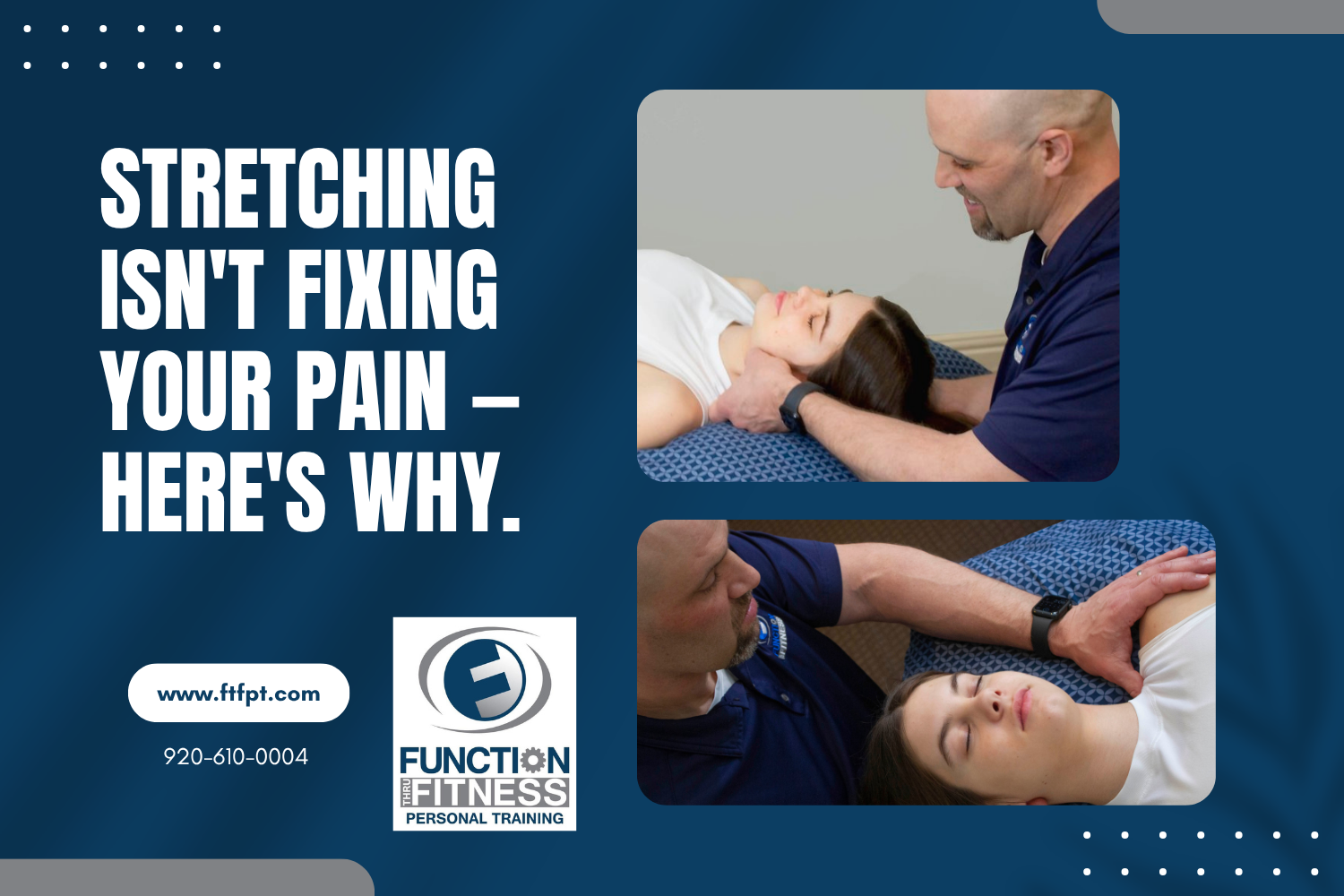
Most people dealing with chronic pain or persistent muscle tightness have tried stretching. Some do it daily. Many have been told by well-meaning sources — trainers, physical therapists, online guides — that tightness means short muscles that need to be lengthened. In this video, we explain why that assumption is frequently wrong, what the research shows about stretching and adhesions, and how the compensation pattern model in nmt therapy changes the approach entirely. If you have been stretching consistently and still asking why does my pain keep coming back, this post covers the clinical answer.
The Adhesion Problem: Why Stretching Works Around the Cause
The first reason stretching often fails to resolve pain involves adhesions — localized areas within muscle tissue where fibers have bound together and lost their normal ability to slide and glide. Adhesions restrict movement, generate tension, and refer pain to other locations. They are a common finding in chronic soft tissue pain presentations.
When you stretch a muscle that contains an adhesion, the stretch does not move through the adhesion. It moves above it and below it. The tissue on either side of the adhesion lengthens. The adhesion itself remains unchanged. You can stretch that muscle every day for months and produce genuine sensation of elongation — and the adhesion will still be there, still restricting movement, still generating the pattern that is causing your pain.
This is not a clinical opinion. It is what the research shows. And it is one of the reasons that best stretch exercises for lower back pain or general stretching routines produce temporary relief without lasting change — the source of the restriction is never contacted.
myofascial release and trigger point therapy addresses this directly. Rather than applying a global stretch that works around the adhesion, specific manual techniques are applied to the adhesion itself — releasing the bound tissue, restoring the ability of the fibers to slide, and removing the restriction that stretching has been unable to reach.
The Compensation Pattern: When Stretching Makes Things Worse
The second issue is the one that surprises most people, and it is clinically more significant: symptomatic tissues are frequently already too long.
This is the compensation pattern. When one structure in the body becomes tight, short, or restricted, the tissues around it adapt. Some of them get pulled into a lengthened position as they work to compensate for what the restricted structure is not doing. Those lengthened, compensating tissues are under sustained tension — and that sustained tension generates pain, stiffness, and the familiar sensation of tightness that sends most people reaching for a foam roller or settling into a long stretch.
The problem is that the tight sensation in a compensating tissue does not mean it is short. It means it is being held long and is complaining about it. When you stretch it further, you are adding length to a tissue that is already too long — and in doing so, you are creating more slack for the true cause, the short restricted structure driving the compensation, to contract further and lock down harder.
Why does my pain keep coming back? For a significant portion of people, this is the direct answer. The tissue being stretched is the symptom. The source is elsewhere. And every stretching session that targets the symptomatic tissue without finding the source gives the actual cause more room to entrench itself.
The Vicious Cycle and How It Develops
Over time, this pattern compounds. The compensating tissue becomes more sensitized. The source structure becomes more restricted. The person stretches the symptomatic area, feels temporary relief from increased blood flow and tissue movement, and then finds the pain has returned — sometimes more firmly than before.
The vicious cycle Stacey describes in this video is not abstract. It is the lived experience of a large portion of people dealing with persistent pain: consistent effort applied in the wrong direction, producing temporary results that never accumulate into lasting change.
Breaking the cycle requires identifying which tissues are symptomatic due to compensation and which tissue is the actual source. That cannot be determined from the outside without assessment — and it cannot be determined by the person themselves, because you cannot see your own movement patterns or evaluate your own compensation structure.
What Neuromuscular Therapy Does Instead
This is the application of neuromuscular therapy massage in cases where stretching has not worked. The assessment process — intake conversation, postural evaluation, range of motion testing, and specific tissue palpation — builds the picture of the compensation pattern. It identifies which tissues are the victims of the pattern and which structure is driving it. Treatment is then directed at the source.
Once the source has been addressed, stretching guidance becomes genuinely useful. The problem is not that stretching has no value — the problem is that it has been applied to the wrong tissue. When the compensation pattern is identified and the source is treated, home care guidance including targeted stretching can be directed at the right location, where it can actually support the progress made in session rather than working against it.
What is neuromuscular therapy used for? This is one of its most direct applications: reversing the cycle that stretching alone cannot break, by finding the source the stretching has been working around.
For those in Green Bay searching for neuromuscular massage therapy near me or therapeutic massage green bay with an assessment-based model, Function Thru Fitness provides precision neuromuscular therapy through Glen, Heather, and Chad — all available to book directly.
Who Provides Neuromuscular Therapy at Function Thru Fitness
Glen Gadwood, CPNMT, LMT, BCTMB, NASM-CES is the owner of Function Thru Fitness and believes pain-free movement is possible at any age, providing neuromuscular therapy and Musculoskeletal Pain Assessment rooted in long-term, root-cause care.
Heather Milton, LMT, NASM-CPT is a licensed massage therapist pursuing advanced certification in neuromuscular therapy, with a focus on pain relief and soft tissue assessment.
Chad Gossen, CPNMT, LMT, NASM-CPT, CES combines neuromuscular therapy with corrective exercise and personal training — offering a uniquely integrated approach for clients navigating both soft tissue and movement issues.
For those searching for massage therapists green bay wi who work from an assessment-first model, all are available to book.
FAQ — Why Stretching Does Not Fix Pain
Q: Why does my pain keep coming back even when I stretch regularly? A: In many cases, the tissue being stretched is compensating for a tighter, restricted structure elsewhere — meaning it is already too long, not too short. Stretching it further gives the actual cause more room to contract. The pain returns because the source has never been found or treated.
Q: Can stretching release adhesions in muscle tissue? A: No. When a muscle with an adhesion is stretched, the tissue above and below the adhesion lengthens — the adhesion itself does not release. myofascial release and trigger point therapy applies specific manual techniques directly to the adhesion, which stretching cannot accomplish.
Q: What is neuromuscular therapy used for in cases where stretching has failed? A: Neuromuscular therapy is used to identify the compensation pattern driving the pain, find the source structure that is generating the compensation, and treat there. Once the source is addressed, stretching guidance can be directed at the correct location — where it can actually support the work rather than deepen the cycle.
Q: How do I know if my pain is from a compensation pattern? A: The clearest signal is that consistent self-treatment — stretching, foam rolling, massage tools — provides temporary relief that does not accumulate. The pain keeps returning to the same area despite ongoing effort. A neuromuscular therapy assessment can identify whether a compensation pattern is involved and where the source is located.
Q: What is the difference between neuromuscular therapy massage and general stretching or massage for pain relief? A: General stretching and massage typically address the location where pain is felt. Neuromuscular therapy massage begins with assessment to determine whether the pain location is also the source location — which it frequently is not. Treatment is then directed at the origin of the pattern rather than the symptom site, which is what produces lasting rather than temporary relief.
Book a Session
Chad - chad@ftfpt.com / 920-915-7831 / www.ftfpt.com/chad
Heather- heather@ftfpt.com / 920-676-9387 / www.ftfpt.com/heather
Glen – glen@ftfpt.com / 920-562-4357 / www.ftfpt.com/glen
Looking for a better way to stay strong, mobile, and pain-free as you age?
At Function Thru Fitness, we go beyond big-box gyms. As one of the established fitness centers green bay wi, our focus is on restoring how the body moves, reducing pain, and building long-term strength through a proven function fitness approach.
We help people move better at every stage of life through personalized training, corrective exercise, golf fitness, neuromuscular therapy, and athlete recovery.
Download our free guide: Essential Exercises for Lifelong Mobility and Independence www.ftfpt.com/essential-exercises
Visit us at 801 Hoffman Rd. Suite 103, Green Bay, WI Book online at www.ftfpt.com